Level 4 Certificate in Fire Risk Assessment

£1800 + VAT – includes all materials, certification and meets BS 8674:2025

London Fire Consultants offers a flexible route to the ProQual Level 4 Certificate in Fire Risk Assessment for learners who need recognised fire risk assessor training that fits around work. You can start the Level 4 fire risk assessor course at any time rather than waiting for a fixed public intake. This gives employers and individual learners more control over staff planning, operational demands, and training delivery.

Face to face Level 4 fire risk assessment training is available at our Farnborough venue or at your location. This makes the course suitable for employers who want in house fire risk assessor training as well as individuals who prefer classroom based learning. On site delivery can also help learners apply fire risk assessment principles in a setting that reflects real buildings, real occupancy risks, and real management arrangements.

The ProQual Level 4 Certificate in Fire Risk Assessment supports progression into intermediate fire risk assessment practice. London Fire Consultants combines start anytime access, face to face teaching, tutor support, and practical guidance to provide a more adaptable route to a recognised Level 4 fire risk assessor qualification.

  • 11th to 15th May 2026

    Level 4 Certificate in Fire Risk Assessment

    *** FULLY BOOKED***

    £1800+VAT

    Maximum of 5 learners.

    Venue: Farnborough, Hampshire, GU14 7NA

  • 8th to 12th June 2026

    Level 4 Certificate in Fire Risk Assessment

    Face to Face Delivery

    £1800+VAT

    Maximum of 5 learners.

    Venue: Farnborough, Hampshire, GU14 7NA

  • 13th to 17th July 2026

    Level 4 Certificate in Fire Risk Assessment

    Face to Face Delivery

    £1800+VAT

    Maximum of 5 learners.

    Venue: Farnborough, Hampshire, GU14 7NA

  • 17th to 21st August 2026

    Level 4 Certificate in Fire Risk Assessment

    *** FULLY BOOKED***

    £1800+VAT

    Maximum of 5 learners.

    Venue: Farnborough, Hampshire, GU14 7NA

  • 14th to 18th September 2026

    Level 4 Certificate in Fire Risk Assessment

    Face to Face Delivery

    £1800+VAT

    Maximum of 5 learners.

    Venue: Farnborough, Hampshire, GU14 7NA

  • 12th to 16th October 2026

    Level 4 Certificate in Fire Risk Assessment

    Face to Face Delivery

    £1800+VAT

    Maximum of 5 learners.

    Venue: Farnborough, Hampshire, GU14 7NA

  • 9th to 13th November 2026

    Level 4 Certificate in Fire Risk Assessment

    Face to Face Delivery

    £1800+VAT

    Maximum of 5 learners.

    Venue: Farnborough, Hampshire, GU14 7NA

  • 7th to 11th December 2026

    Level 4 Certificate in Fire Risk Assessment

    Face to Face Delivery

    £1800+VAT

    Maximum of 5 learners.

    Venue: Farnborough, Hampshire, GU14 7NA

The ProQual Level 4 Certificate in Fire Risk Assessment provides a nationally recognised qualification for those currently working in, or who want to work in the Fire Safety sector. This qualification has been developed with, and aligned to, the intermediate risk buildings fire risk assessment competencies outlined in BS 8674: 2025 – Built Environment Framework for Competence of Individual Fire Risk Assessors.

ProQual logo with the text 'ProQual' in blue on a black background.

Who Should Apply

This Fire Safety College course is designed for professionals who work in, advise on, or hold responsibility for fire safety in intermediate risk buildings.

It is suitable for:

• Regulators, including fire and rescue services, building control approvers, and enforcement officers

• Assessors, including fire risk assessors, fire safety consultants, and auditors

• Designers, including architects and building designers working on new and existing buildings

• Dutyholders, including responsible persons, building owners, and facilities managers

Intermediate Risk Buildings

Intermediate risk buildings are premises where fire risk assessment calls for broader technical knowledge and sound professional judgement than is usually needed for straightforward low risk buildings. These buildings may involve more complex occupancy profiles, larger or more varied layouts, higher numbers of occupants, more complex fire protection systems, or construction features that require closer examination. The assessor must be able to evaluate means of escape, fire development and spread, passive and active fire protection measures, and the influence of human behaviour on evacuation and emergency arrangements.

Why Take This Course?

  • RQF Level 4 qualification in fire risk assessment

  • Maximum of 5 delegates per course to maintain a high quality learning experience

  • Delivered face to face by practising Advanced Tier fire risk assessors who also hold training, education, and assessing qualifications

  • Fully aligned to BS 8674

  • Includes live teaching, practical scenarios, and final assessment activity

  • Prepares learners to undertake fire risk assessments in intermediate risk buildings

What’s Covered in the Level 4 Certificate Fire Risk Assessment

The ProQual Level 4 Certificate in Fire Risk Assessment is an intermediate qualification designed to develop both the knowledge and practical competence needed for fire risk assessment work. It is explicitly aligned to the intermediate fire risk assessor competencies set out in BS 8674:2025.

The qualification consists of five mandatory units, so learners complete the full programme rather than selecting optional modules. It has a Total Qualification Time of 245 hours, including 160 Guided Learning Hours, and is assessed on a pass or fail basis through internal assessment with external quality assurance by ProQual, an Ofqual regulated awarding body.

Introduction to Fire Risk Assessment in Intermediate Risk Buildings.

This unit introduces the learner to fire risk assessment methodology and the key stages in the assessment process. It covers the core principles of assessing both low and intermediate risk buildings, together with human behaviour in fire and the management of evacuation in realistic conditions. It also addresses the needs of people who may be at increased risk and how those needs should be identified and considered during assessment and planning.

Reviewing, Challenging, and Reporting on Fire Risk Assessment Materials

This unit develops the ability to critically review fire risk assessment materials and test the robustness of the findings. Learners examine at least two example fire risk assessments, identify significant concerns, recommend improvements, and recognise when risk becomes intolerable and immediate action is required. It also develops reporting skills and the confidence to challenge weak or flawed assessments in a professional and evidence based way.

Current Legislation and Enforcement Context

This unit covers the legal framework that underpins fire safety practice, including the Regulatory Reform (Fire Safety) Order 2005, the Fire Safety Act 2021, the Fire Safety (England) Regulations 2022, the Building Safety Act 2022, and the Health and Safety at Work etc. Act 1974. Learners consider dutyholder responsibilities, the consequences of non-compliance, and the roles of regulators, enforcing authorities, and fire and rescue services.

Undertaking a Fire Risk Assessment for a Low Risk Building

This is a practical, competence-based unit. Learners plan and carry out a simulated fire risk assessment using recognised methodologies. They gather evidence through physical inspection, including the assessment of fire doors, compartmentation, and external walls, before producing recommendations, action plans, and immediate control measures where risk is found to be unacceptable. The unit also develops the communication skills needed to engage with relevant persons and present findings clearly.

Managing and Completing Assessments in Intermediate Risk Buildings

This unit develops technical understanding of fire spread limitation in relation to compartmentation, external walls, roofs, and attachments. Learners explore how to identify where fire spread control may be inadequate and when further investigation is required, including circumstances in which a FRAEW may be necessary. The unit also covers the contribution of fire protection systems to safety, including detection, suppression, passive fire protection, smoke control, electrical safety, and lightning protection, together with product testing, certification, specification, and commissioning. Learners then apply this knowledge to plan and produce an intermediate risk building fire risk assessment, including consideration of project resourcing, timescales, cost, and challenging conversations with duty-holders and residents.

The qualification also makes professional development a core requirement. Learners reflect on their strengths and development needs, prepare a personal development plan, and present an aspect of their own practice to peers. This helps ensure that they leave with a continuing professional development mindset rather than simply a one-off certificate.

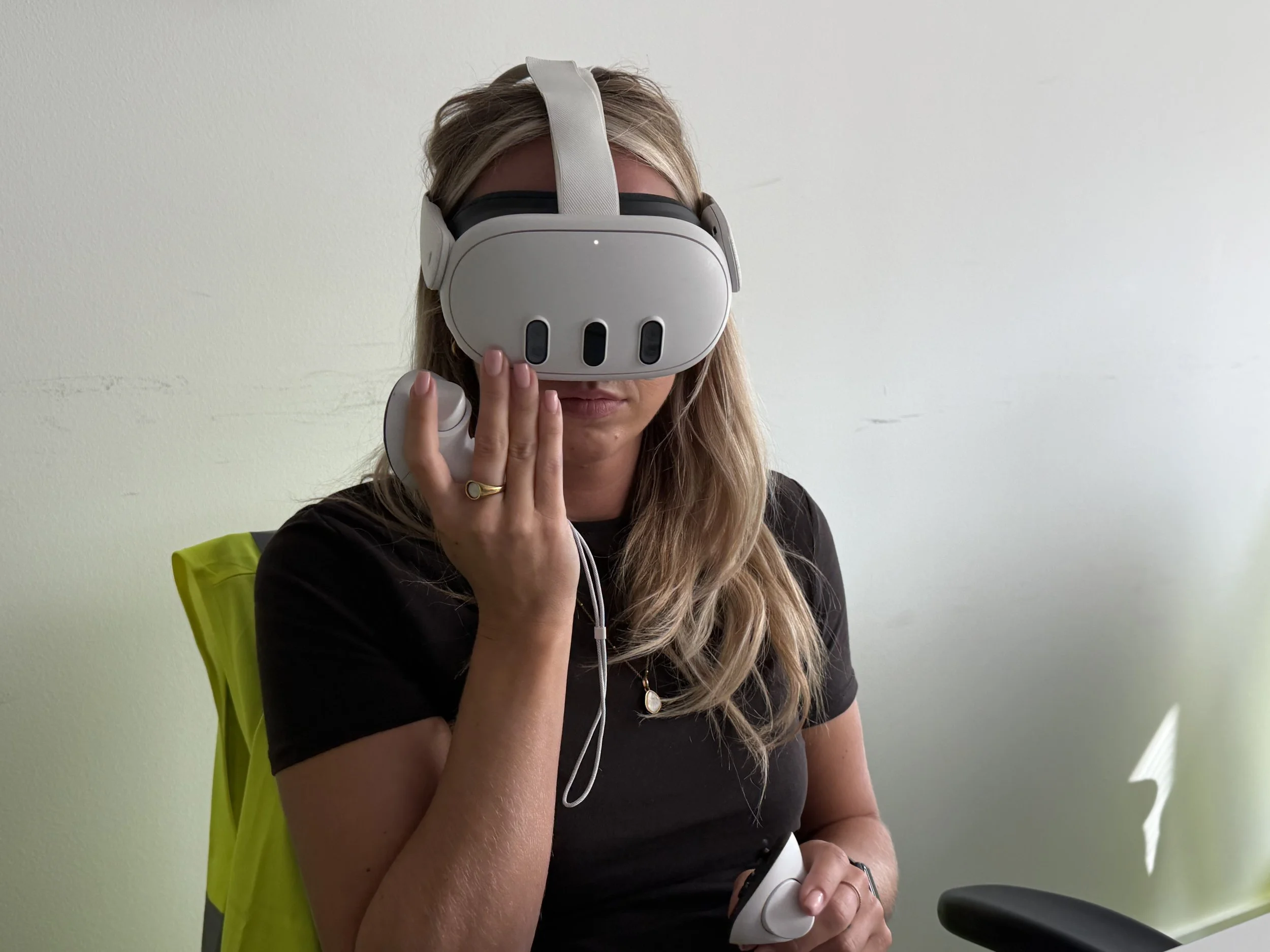
VR Headset on a desk

VR being used to identify fire hazards in a hotel dining room.

We use Virtual Reality on our Courses

Virtual reality training helps bring fire risk assessor training closer to real practice. It gives learners the chance to step into realistic building environments and work through fire safety scenarios in a controlled setting. Rather than relying on theory alone, VR is used to support practical observation, structured discussion, and applied decision making. This makes training more interactive and gives learners a clearer understanding of how fire safety issues appear in buildings.

In VR, learners can practise identifying the types of issues they are expected to recognise during a fire risk assessment. This can include blocked escape routes, poor housekeeping, unsuitable storage, fire door defects, hazards linked to electrical equipment, and weaknesses in fire safety management. Learners can also explore how building layout, occupancy, and use affect risk. The aim is not just to spot faults, but to think critically about what those faults mean, who may be at risk, and what action may be required.

VR supports real world assessor competence by helping learners apply knowledge in a practical context before moving into live premises. It strengthens observation, improves confidence, and encourages more disciplined professional judgement. Learners are not simply reading guidance or listening to explanations. They are testing what they know against realistic scenarios and learning how to justify their conclusions. Used properly, VR supports the development of better fire risk assessors by helping bridge the gap between classroom learning and real building assessment.

Each learner is provided with an iPad for the full duration of the classroom course.

The iPad is used to support research during taught sessions, access key standards and legislation, work through guided learning activities, use the specialist fire risk assessor platform RiskBase, and record evidence from practical exercises.

This helps learners work in a way that reflects modern fire risk assessment practice and gives them direct experience of using digital tools during the course.

Practical sessions on the course.

Learners also take part in burn test practicals to help them understand how different materials behave when exposed to heat and flame.

These practical sessions are designed to develop a better understanding of material properties, fire development, surface spread of flame, ignition, smoke production, and the way construction products can contribute to fire growth.

By seeing these behaviours first hand, learners gain a stronger and more practical understanding of how material performance can influence fire risk assessment findings.

The aims of this qualification are:

  • To develop foundation and intermediate fire risk assessment competence.

  • To prepare candidates to undertake and report fire risk assessments effectively.

  • To promote a culture of continuous personal development and sharing best practice in the field of fire risk assessment.

FAQs

  • Candidates for this qualification should:

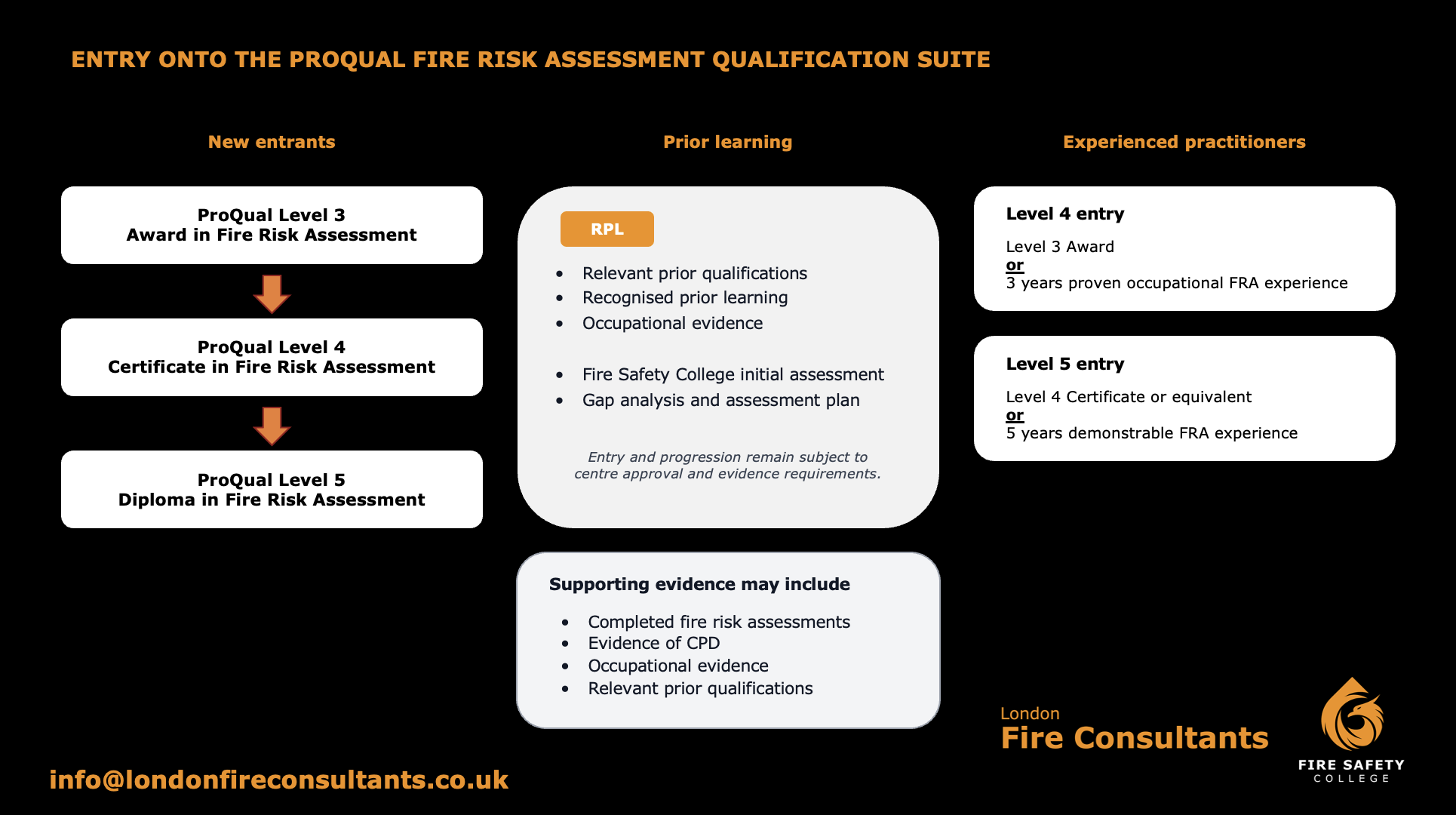
    • Hold the ProQual Level 3 Award in Fire Risk Assessment OR

    • Have at least three years proven occupational experience in the field of fire risk assessment.

  • Yes. It is accredited by Ofqual and delivered by ProQual AB, a recognised awarding body. It is listed on the Regulated Qualifications Framework (RQF).

  • Intermediate Risk Buildings

    Intermediate risk buildings are premises where fire risk assessment requires broader technical knowledge and professional judgement than is usually needed for straightforward low risk buildings. These buildings may involve more complex occupancy profiles, larger or more varied layouts, higher occupant numbers, more complex fire protection systems, or construction features that require closer scrutiny. The assessor must be able to evaluate means of escape, fire development and spread, passive and active fire protection measures, and the effect of human behaviour on evacuation and emergency arrangements.

  • Yes. After the 5-day face-to-face training, you will complete written assignments applying the principles you’ve learned. Most learners finish this within 6 weeks.

  • Yes. This qualification can be completed fully online, with remote access to learning materials, tutor support, assessment guidance, and assignment submission throughout the course.

  • You’ll have direct access to tutors during the course, and email support after the course for your final assessments. You’ll also receive resources and templates to help you succeed.

  • Yes. This qualification can support progression into fire risk assessment roles, strengthen professional credibility, and help learners demonstrate competence when working in intermediate risk buildings.

  • Talk to us. We’ll try to rebook you onto a future course or make arrangements depending on the content missed.

  • Click “Enrol Now” on this page or download the course guide to find out more. You can also speak to a course advisor to check your eligibility.

    info@londonfireconsultants.co.uk

  • No, however there are numerous hotels in the local areas, most within walking distance.

    Nearby Hotels & Distances

    • Village Hotel Farnborough – Contemporary 4-star; ~0.4 miles from GU14 7NA. Offers parking, gym, pool—great for both business and leisure

    • HQ Aparthotel Farnborough – 4-star serviced apartments; ~0.1 miles from us

    • The Falcon Hotel – 3-star central hotel; about 0.8 miles from GU14 7NA,

    • Colebrook Guest House – Comfortable 3-star guest house; around 0.8 miles away

    • Premier Inn Farnborough Town Centre – Budget-friendly; approx. 1 mile

    • Holiday Inn Farnborough by IHG – Business-class 4-star; ~1.3 miles

  • No, however we do provide light refreshments throughout the course and a number of food outlets are available within a short walk.

  • No, however a list of nearby car parks will be provided as part of your joining instructions.

  • Please contact us before booking so we can discuss any access requirements and make appropriate arrangements.

  • The classroom course is delivered over five days. After this, learners complete the required assignments. Most learners complete the full qualification within around six weeks, although this can vary depending on individual circumstances, availability, and study time.

Your Instructor: Simon Tudor BSc (Hons) APAEWE FSIDip NCRQCert MIFSM Tech IOSH

A portrait of a man with short dark hair and blue eyes, wearing a dark suit, white shirt, and maroon tie against a neutral background.

Simon is highly skilled Fire Safety Specialist, Lead Trainer, and Training Designer with expertise in fire risk assessment, training program development, and compliance with UK fire safety requirements. 

Founder of London Fire Consultants (est. 2018), delivering specialist consultancy and fire safety training to high-risk environments, industrial sites, healthcare, heritage buildings, and complex structures.

A Tier 3 IFSM Registered Fire Risk Assessor (Complex Buildings) and BAFE SP205 Validator, having conducted over 400 fire risk assessments in the last few years, ensuring compliance across industrial, historic, healthcare, and high-risk residential properties. Keen interest in VR-integrated fire safety training programs, developing realistic, scenario-based simulations for practical learning for Trainee Fire Risk Assessors.

Achieved the highest course score on the EAL Level 3 Award in Fire Detection & Fire Alarm Systems (BS 5839-1:2017) and has been frequently featured as a Fire Safety Expert on Channel 5 and in the Daily Telegraph newspaper, translating complex fire safety regulations into easily understandable explanations.

PROFESSIONAL MEMBERSHIPS

FIA (Fire Industry Association)

IOSH (Institution of Occupational Safety and Health) – Technical Member (Tech IOSH)

MIFSM (Member of the Institute of Fire Safety Managers)

National Register of Fire Risk Assessors – TIER 3 (Complex Buildings)


Logo for INERAR with a checkmark inside a box, the words INERAR, Advanced Level, and the year 2026.
Logo of the Institute of Fire Safety Managers (IFSM) with a red flame above the organization's initials, and the text 'The Institute of Fire Safety Managers' in a circular pattern around the flame, with 'Member' below.
The ProQual logo in blue text on a black background.

Fire Safety and Fire Risk Assessment
Level 7 Award in The Advanced Professional Award in Expert Witness Evidence (APAEWE)

Tier 3 IFSM National Register of Fire Risk Assessors (Complex Buildings) – Fire risk assessment of high-risk, multi-use, and complex structures

BAFE SP205 Validator – Conducting validated, UKAS-accredited fire risk assessments

Level 6 Diploma in Building Safety Management

Level 6 Certificate in Fire Safety in Construction

EAL Level 3 Award in Fire Detection & Fire Alarm Systems (BS 5839-1:2017) (Achieved Highest Score) – Fire alarm system design, installation, and maintenance

EAL Level 3 Award in the Servicing and Maintenance of Portable Fire Extinguishers (Achieved Highest Score) 

Fire Service College Fire Risk Assessor – Advanced fire risk assessment techniques

Fire Suppression System Design – Designing mist, gas, and sprinkler systems

Fire Engineering Design – Structural fire protection and means of escape planning

IFSM – Fire Risk Assessor Validator Course

Zeus Training – 1 day Emergency Lighting

Fire Door Surveyor – Regulatory compliance and fire door maintenance inspections

IOSH Evacuation Chair Trainer

Firefighting and Command Training

STCW Fire Fighting – Marine firefighting, emergency response, and fire suppression systems

Royal Navy Advanced Fire Fighting – High-risk incident management and BA operations

Royal Navy Command & Control (Fire) – Crisis coordination and tactical decision-making in fire incidents 

Training and Education Qualifications

Level 4 Teaching Qualification – Curriculum development and classroom-based training techniques

Level 3 Certificate in Assessing Vocational Achievement – Competency-based assessment of fire safety professionals

Level 4 Internal Quality Assurance of Assessment Processes & Practice – Ensuring high standards in fire safety education and assessment

IOSH Evacuation Chair Trainer – Safe evacuation techniques for disabled and mobility-impaired individuals

First Aid Trainer – Workplace CPR, trauma response, and medical emergency training

Fire Safety Trainer – Delivering regulated (Ofqual) Level 1 and Level 2 awards in Fire Safety

First Aid for Mental Health Trainer – Delivery up to and including Level 3 qualifications

Health & Safety and Compliance

P402 Asbestos Surveyor – Asbestos identification, risk management, and compliance.

Level 6 Building Safety Management Diploma 

Level 6 Certificate in Applied Health and Safety

Level 6 Certificate in Personal Injury Liability and Absence Reduction

Level 2 Award Manual Handling

DSEAR Assessor – Risk assessment for Explosive atmospheres (BRE)

Level 3 Award in First Aid at Work

Level 2 Award in Oxygen Therapy

Level 2 Award in Management of Anaphylaxis

Level 3 Award in Supervising First Aid for Mental Health

Level 2 Certificate in Self-harm and Suicide Awareness and Prevention

IOSH Managing Safely

  • Proper training is essential as money spent on cheap training and substandard training is money wasted. Spending it on this sort of training is an investment in your people. It’s not a cost.

    Dame Judith Hackitt

How The Fire Safety College’s ProQual Level 4 Certificate in Fire Risk Assessment Maps to BS 8674:2025

BS8674 Front Cover

The ProQual Level 4 Certificate in Fire Risk Assessment delivered by The Fire Safety College at London Fire Consultants is aligned to the intermediate fire risk assessor competencies set out in BS 8674:2025. ProQual confirms that the qualification has been developed in line with BS 8674:2025 and that its learning outcomes and assessment criteria have been mapped to the knowledge, competencies and legislation identified in the standard.

This gives learners a regulated Level 4 route built around the current British Standard for individual fire risk assessor competence, with a focus on structured development, assessed evidence and progression into intermediate level fire risk assessment practice. The qualification is on the RQF, carries 245 Total Qualification Time and 160 Guided Learning Hours, and is internally assessed with external quality assurance by ProQual.

Why BS 8674 matters

BS 8674:2025 sets out a competence framework for individual fire risk assessors. The standard recognises three levels of competence: Foundation, Intermediate and Advanced. It also makes clear that each level builds on the one below and that fire risk assessors should not work beyond the limits of their competence.

That matters because fire risk assessment is not simply about completing a form or following a checklist. A competent assessor needs the right mix of technical knowledge, practical skill, professional judgement and ethical behaviour. BS 8674 was written to provide a benchmark that can be used by awarding bodies, training providers, employers, dutyholders and those appointing fire risk assessors.

For learners, that means the right qualification should do more than deliver teaching hours. It should help build competence in a structured and evidence based way. That is the role the ProQual Level 4 Certificate is designed to fulfil.

How the ProQual Level 4 maps to BS 8674

ProQual states that the Level 4 Certificate in Fire Risk Assessment has been developed with, and aligned to, the intermediate fire risk assessment competencies outlined in BS 8674:2025. ProQual also states that the learning outcomes and assessment criteria have been mapped to the knowledge, competencies and legislation identified in the standard.

The qualification is intended to build Foundation and Intermediate level competence, not Advanced level competence. That mirrors the structure of BS 8674, which says that Intermediate competence assumes the criteria for the previous level have already been met. This is an important distinction for website wording because it is more accurate to describe the qualification as an intermediate level route than to imply that it covers every level of fire risk assessment practice.

The structure of the qualification covers both low risk and moderate risk fire risk assessment. This reflects the intended progression into intermediate level practice rather than high risk or specialist advanced work. BS 8674 Annex C explains that Intermediate competence broadly aligns with moderate fire risk premises, while higher risk premises would require Advanced competence.

BS 8674 also expects fire risk assessors at all levels to demonstrate professional and ethical competence. The ProQual Level 4 supports that expectation through portfolio based assessment, authenticated evidence and a dedicated unit on professional development as a fire risk assessor. This matters because competent fire risk assessment is not limited to technical knowledge. It also depends on judgement, behaviour, communication and the ability to reflect on one’s own practice.

BS 8674 positions the fire risk assessor as someone who identifies hazards, explains solutions, reports on fire risk issues, reviews previous assessments and recommends fire safety measures to manage residual risk. The ProQual Level 4 supports that role through assessed evidence such as assignments, projects, reports, professional discussion and questioning. That gives the qualification a stronger competence base than a course that relies on attendance alone.

Continuous personal development is also part of the stated aim of the qualification. That aligns with BS 8674, which frames competence as an ongoing professional responsibility rather than a one off achievement. A learner does not become fully developed simply by passing a course. Competence has to be maintained, reviewed and strengthened over time.

What learners study on the ProQual Level 4 Certificate

The ProQual Level 4 Certificate in Fire Risk Assessment consists of five mandatory units. Together, these units are structured to develop technical understanding, practical assessment ability, moderate risk building knowledge and professional development.

The qualification includes Introduction to Intermediate Fire Risk Assessment, Undertaking a Fire Risk Assessment for a Low Risk Building, Managing the Risk of Fire in Moderate Risk Buildings, Fire Risk Assessment for a Moderate Risk Building, and Understanding Professional Development as a Fire Risk Assessor. This unit structure is significant because it shows that the qualification does not try to skip straight into moderate risk assessment without first building lower level assessment competence and then extending that into broader management, reporting and development skills.

Related pages can support user journey and internal SEO. Appropriate internal links would include the ProQual Level 3 Award in Fire Risk Assessment page, the ProQual Level 5 Diploma in Fire Risk Assessment page, and the Fire Risk Assessment Services page.

Entry requirements

ProQual states that candidates for this qualification should either hold the ProQual Level 3 Award in Fire Risk Assessment or have at least three years of proven occupational experience in the field of fire risk assessment. Candidates must also be at least 18 years old on the day they are registered.

Centres are also expected to carry out an initial assessment of candidate knowledge and skills to identify gaps and help determine the assessment plan. That supports a more robust route into training and helps make sure learners are entering at the right level. It also helps avoid the weaker and often misleading marketing position that any learner can start at any level without relevant prior development or experience.

Assessment and quality assurance

The ProQual Level 4 Certificate is assessed through a portfolio of evidence. Candidates are required to demonstrate achievement of all learning outcomes and assessment criteria for each unit. Evidence can include assignments, projects, reports, professional discussion, candidate product, worksheets and records of questioning.

Assessment decisions are made by occupationally competent assessors. Candidate portfolios are internally verified by centre staff and externally quality assured by ProQual Verifiers. That matters because competence in fire risk assessment should be judged through evidence, not attendance alone. A portfolio based qualification provides a stronger framework for demonstrating what the learner can actually do, how they reason, and whether they can apply knowledge in a way that stands up to scrutiny.

Progression routes

ProQual states that candidates who complete the Level 4 Certificate in Fire Risk Assessment may progress onto the ProQual Level 5 Diploma in Fire Risk Assessment.

For learners planning a longer term pathway, that makes the Level 4 Certificate an important step between Foundation level development and more advanced study. It also supports clearer website messaging around progression rather than treating the qualification as a final destination for every learner.

Frequently asked questions

What is the ProQual Level 4 Certificate in Fire Risk Assessment?

The ProQual Level 4 Certificate in Fire Risk Assessment is a regulated Level 4 qualification on the RQF designed to build Foundation and Intermediate fire risk assessment competence.

Is the ProQual Level 4 aligned to BS 8674?

Yes. ProQual states that the qualification has been aligned with BS 8674:2025 and that the learning outcomes and assessment criteria have been mapped to the knowledge, competencies and legislation identified in the standard.

Does this qualification cover advanced level fire risk assessment?

No. The more accurate position is that the qualification is designed to build Foundation and Intermediate competence. It should not be presented as an Advanced level qualification.

What buildings is the qualification aimed at?

The qualification structure is aimed at low risk and moderate risk fire risk assessment work, which aligns with the Intermediate level pathway in BS 8674.

What units are included in the qualification?

The qualification includes five mandatory units covering intermediate fire risk assessment, low risk buildings, moderate risk buildings, fire risk management and professional development.

How is the qualification assessed?

Learners complete a portfolio of evidence. Evidence can include reports, assignments, projects, professional discussion, worksheets and questioning.

Who can enrol on the course?

Candidates should normally hold the ProQual Level 3 Award in Fire Risk Assessment or have at least three years proven occupational experience in fire risk assessment. An initial assessment should also be carried out to identify knowledge and skill gaps.

What can learners do after completing the qualification?

Successful learners may progress to the ProQual Level 5 Diploma in Fire Risk Assessment.

BS 8674 to ProQual Level 4 Certificate in Fire Risk Assessment Mapping

BS 8674 competency area BS 8674 requirement summary ProQual Level 4 unit or qualification content that maps to it Mapping judgement
Professional and ethical behaviour Fire risk assessors should act professionally, communicate clearly, work within competence and reflect ethical behaviour. The qualification includes a dedicated professional development unit requiring learners to identify principles of personal development, reflect on their expertise, identify strengths and areas for improvement, and produce a development plan. The introductory unit also requires learners to evaluate fire risk assessments and report findings clearly. Strong
Limits of competence Assessors should understand the limits of their competence and recognise when immediate action or further specialist input is needed. The low risk assessment unit requires learners to evaluate when fire risk is intolerable and produce an immediate action plan. The moderate risk management unit also requires learners to identify when fire spread controls are inadequate and when further investigation is needed, including where specialist assessment such as a FRAEW may be required. Strong
Principles and scope of fire risk assessment Assessors should apply theoretical and practical approaches, use evidence based methods, analyse information, produce proportionate recommendations and report clearly. The qualification includes an introduction to intermediate fire risk assessment, a low risk assessment unit and a moderate risk assessment unit. Together these units cover methodology, planning, analysis of information, use of evidence, immediate action thresholds, reporting and communication. Strong
Fire safety legislation and guidance Assessors should understand enforcing authority roles, legal duties, wider fire safety legislation and firefighting access requirements. The introductory unit covers core legislation, including the Fire Safety Order, Fire Safety Act, Fire Safety Regulations, Building Safety Act and Health and Safety at Work Act, together with the role of enforcing authorities. The moderate risk assessment unit also covers legal recommendations and firefighting access considerations. Strong
Fire development and spread Assessors should evaluate compartmentation, external wall issues, occupancy factors and other matters affecting fire development and spread. The moderate risk management unit covers compartmentation, external walls, roofs, attachments, further investigation needs, FRAEW triggers and the effect of contents, occupancy type and building use on fire risk. The low risk assessment unit also requires consideration of compartmentation and external wall issues during assessment. Strong
Building design, construction and maintenance Assessors should understand how construction features, maintenance issues and specialist systems affect fire safety performance. The moderate risk management unit covers fire detection, suppression, passive fire protection, smoke control, electrical safety, lightning protection, product testing, certification, specification and commissioning. It also introduces the role of fire engineering solutions where standard guidance alone is not sufficient. Strong
Fire risk management systems Assessors should understand how management systems, policies and procedures contribute to overall fire safety. The qualification includes a dedicated unit on managing the risk of fire in moderate risk buildings. The moderate risk assessment unit also requires learners to communicate recommendations that improve or maintain fire safety management processes and systems. Moderate to strong
Personal performance and situational awareness Assessors should evaluate their own work, identify development needs, set objectives and maintain continuing competence. The low risk assessment unit requires critical evaluation of a simulated assessment and identification of development needs, objectives and planning targets. The professional development unit reinforces reflective practice and structured development planning. Strong
Personal development and CPD Assessors should develop vocational skills, maintain competence and keep knowledge current. The professional development unit requires learners to identify principles of development, reflect on their vocational practice, identify strengths and weaknesses, and produce a personal development plan. The overall qualification structure also supports evidence based professional growth through portfolio assessment. Strong
Moderate risk premises competence Intermediate assessors should be able to assess moderate risk premises and provide proportionate recommendations. The qualification includes both a moderate risk knowledge unit and a separate moderate risk fire risk assessment unit. This gives learners both the technical underpinning and the applied assessment element expected at intermediate level. Strong
Foundation competence carried into intermediate practice Intermediate competence should build on foundation level competence rather than bypass it. The qualification is designed to build both Foundation and Intermediate competence. This is reflected in the structure, which includes a low risk assessment unit before progressing to moderate risk management and moderate risk assessment. Strong
Communication with dutyholders and stakeholders Assessors should communicate clearly in writing and verbally with dutyholders and those responsible for fire safety. The qualification requires learners to produce clear reports, understandable action plans and effective recommendations. It also includes relationship building, managing difficult conversations and communicating findings in a way that supports fire safety improvement. Strong
Evidence based assessment and proof of competence Competence should be demonstrated through evidence, not simple attendance. The qualification is assessed through a portfolio of evidence. Acceptable evidence includes assignments, projects, reports, professional discussion, questioning, worksheets and other assessed outputs. This supports a more robust demonstration of competence than attendance based training alone. Strong

Summary of the mapping

The ProQual Level 4 Certificate in Fire Risk Assessment maps strongly to the main themes of BS 8674 intermediate competence. The clearest alignment is in methodology, legislation, low risk and moderate risk fire risk assessment, fire development and spread, reporting, communication and continuing professional development.

The qualification also reflects the principle that intermediate competence should build on foundation competence rather than skip straight to more complex work. That is a key strength because it supports a structured progression pathway.

BOOKING FORM.
LEVEL 4 CERTIFICATE IN FIRE RISK ASSESSMENT

The ProQual Level 4 Certificate in Fire Risk Assessment is an intermediate qualification designed to develop both the knowledge and practical competence needed for fire risk assessment work. It is explicitly aligned to the intermediate fire risk assessor competencies set out in BS 8674:2025.

COST: £1800 + VAT