
PAS 9980:2026: What the September 2026 Revised Standard Means for External Wall Fire Risk Appraisals
PAS 9980 has undergone its first major revision since its introduction in 2022.
The new edition, PAS 9980:2026, provides a revised methodology for determining whether a Fire Risk Appraisal of External Walls, or FRAEW, is required and, where one is necessary, how the appraisal should be undertaken.
The revision is significant for building owners, Responsible Persons, managing agents, fire risk assessors, fire engineers and other professionals involved in the management of residential buildings.
Importantly, the revised PAS does not simply introduce a new assessment format. It strengthens the risk based and proportionate approach that underpins the FRAEW process.
PAS 9980:2026 supersedes PAS 9980:2022. However, publication of the revised edition does not automatically invalidate FRAEW reports prepared under the 2022 edition. Whether an existing report requires review or updating remains a matter for the dutyholder, taking account of professional advice and the circumstances of the building.
What is PAS 9980?
PAS 9980 provides a methodology for assessing the risk to occupants arising from fire spreading over or within the external walls of an existing building.
The process is known as a Fire Risk Appraisal of External Walls.
The appraisal considers matters including:
• The construction of the external wall
• Cladding and insulation materials
• Cavities and cavity barriers
• The configuration and extent of external wall systems
• Balconies and other attachments
• The potential for secondary fires
• The building's evacuation strategy
• Means of escape
• Compartmentation
• Smoke control
• Fire detection and alarm arrangements
• Fire and rescue service access and intervention
The FRAEW is intended to inform the wider fire risk assessment. It is not a replacement for the building's FRA.
This distinction is important.
PAS 9980 is concerned with risk to life from external wall fire spread. It is not simply an exercise in determining whether the external wall complied with Building Regulations when the building was constructed.
What has changed in PAS 9980:2026?
The 2026 edition is a full revision rather than a minor amendment.
Several changes will have practical consequences for those commissioning and undertaking FRAEWs.
1. Not every building requires an FRAEW
One of the most useful changes is a clearer process for deciding whether an FRAEW is required in the first place.
The revised PAS specifically recognises that an FRAEW is not necessary for every building or every external wall construction.
The standard introduces a clearer triage process.
Certain buildings can be regarded as inherently low risk in relation to external wall fire spread. These include detached houses, terraced and semi detached houses, blocks of flats with no more than two storeys above ground, and certain three storey blocks where there is no obvious external wall hazard.
There are also circumstances where the construction of the external walls themselves can establish sufficiently low risk without progressing to a full FRAEW.
This is an important change in approach.
Commissioning a full FRAEW should not become an automatic administrative response simply because a building has external walls or contains some combustible material.
The first question should now be:
Does this building actually require an FRAEW?
2. Four risk outcomes replace the previous three band approach
PAS 9980:2022 used three broad outcomes:
Low
Medium
High
The revised edition introduces four:
Low
Tolerable
Medium
High
The new tolerable category effectively separates what was previously described as the lower, tolerable part of the medium risk band.
This is more than a change in terminology.
A risk rating and a risk outcome are not the same thing.
The risk rating considers the hazard, probability and consequences associated with external wall fire spread.
The risk outcome then considers that risk in the context of whether further risk reduction is proportionate.
This distinction should help prevent an overly simplistic interpretation that the presence of combustible materials automatically means extensive remediation is required.
3. Proportionality is central to the assessment
PAS 9980:2026 reinforces the principle that external wall fire safety should be assessed according to risk rather than through a binary compliant or non compliant approach.
The FRAEW should consider the benefit of proposed measures alongside their practicability, cost and effect on risk.
That does not mean cost overrides life safety.
It means remediation and mitigation should address the actual risk presented by the building.
The PAS specifically recognises that mitigation, partial remediation or full replacement of an external wall system can represent different proportionate responses depending upon the circumstances.
This is particularly important when combustible materials are identified.
Combustible does not automatically mean dangerous.
Equally, evidence that an individual material achieves a particular reaction to fire classification does not, by itself, establish that the complete external wall arrangement presents an acceptable risk.
The whole system and the building in which it is installed must be considered.
4. The FRAEW process is more clearly structured
The revised standard makes the assessment methodology more explicit.
The process considers three principal groups of risk factors:
• Fire performance
• Façade configuration
• Fire strategy and associated fire hazards
These factors are considered individually and then collectively to determine the overall external wall fire risk.
This is important because external wall risk cannot reliably be determined from the combustibility of one product alone.
For example, an assessor may need to consider how combustible material is positioned within the wall, whether cavities exist, whether cavity barriers are present and effective, how extensively the system covers the building, its relationship with windows and escape routes, and how external fire spread could affect the building's evacuation strategy.
The revised methodology therefore requires the assessor to understand the building as a fire safety system rather than assessing the façade in isolation.
5. The process is explicitly iterative
Another important development is the clearer recognition that an FRAEW may develop as evidence becomes available.
The appraiser can initially work with available information and reasonable worst case assumptions.
If the outcome is clearly low risk despite uncertainty, further intrusive investigation may provide little safety benefit.
Where uncertainty materially affects the risk outcome, further investigation may be justified.
This could include:
• Additional document review
• Further site inspection
• Intrusive investigation
• Additional technical analysis
• Fire testing where proportionate
The purpose is not to investigate until every uncertainty has disappeared.
The purpose is to obtain enough reliable information to make a defensible risk based decision.
PAS 9980:2026 specifically recognises that additional certainty should only be pursued where the benefit justifies the cost and impact.
6. Competence receives greater attention
PAS 9980:2026 reinforces an issue that should concern anyone commissioning this work.
A FRAEW is specialist work.
Different parts of the process may require different competencies.
Document review, façade inspection, fire performance assessment and advanced fire engineering analysis do not necessarily require the same professional skill set.
The standard therefore recognises that additional specialists may need to contribute where the external wall construction or analysis exceeds the competence of the principal appraiser.
This also means that appointing someone simply because they undertake general fire risk assessments is not sufficient evidence that they are competent to undertake an FRAEW.
Competence must relate to the work actually being undertaken.
7. Peer review has a clearer role
The revised edition introduces more detailed guidance on reviewing FRAEW reports.
This is significant because an FRAEW can contain substantial professional judgement.
Peer review can therefore provide additional assurance where the building, wall construction or analysis is complex.
However, the revised approach remains proportionate.
A straightforward assessment producing an obvious outcome does not necessarily require the same level of independent review as a complex appraisal where professional judgement materially influences whether remediation is required.
8. FRAEW reports need to explain the reasoning
The revised reporting provisions are more detailed.
This should improve the quality of FRAEW reports.
A report should not simply state:
"Medium risk"
or
"Remediation required."
The reader needs to understand how that conclusion was reached.
PAS 9980:2026 requires the report to explain the risk outcome, the relative significance of the risk factors and the professional judgements used in reaching the conclusion.
Where uncertainty contributes to a medium or high outcome, the report should also explain why further appraisal work was not possible or proportionate.
This creates a stronger audit trail.
It should also make it easier for Responsible Persons, fire risk assessors, enforcing authorities and other professionals to understand and challenge the conclusions where necessary.
9. Residents should be able to understand the outcome
Technical reports can become inaccessible to the people most affected by their conclusions.
PAS 9980:2026 addresses this directly.
FRAEW reports should include an executive summary that can be readily understood by non specialists, including residents.
That summary should explain the building, wall systems, overall risk outcome, how that outcome was reached and any recommended mitigation or remediation.
This is a positive development.
A technically correct assessment has limited value if the dutyholder and residents cannot understand what the findings mean.
10. Existing PAS 9980:2022 reports do not automatically become obsolete
This is likely to be one of the first questions asked by building owners and managing agents.
Does every existing PAS 9980:2022 FRAEW now need to be replaced?
No.
The revised PAS expressly states that its publication does not, by itself, invalidate reports prepared under PAS 9980:2022.
The dutyholder should instead consider whether review is appropriate.
Relevant factors could include changes to the external wall, new evidence about materials or systems, changes affecting the building's fire strategy, significant uncertainty in the original assessment or other circumstances that could materially affect the original conclusions.
Automatically recommissioning every FRAEW purely because the standard has changed would conflict with the risk based and proportionate philosophy of PAS 9980 itself.
What does PAS 9980:2026 mean for the Fire Risk Assessment?
An FRAEW should not sit in a building safety file disconnected from the FRA.
Its purpose is to inform the fire risk assessment.
Where the FRAEW identifies significant external wall risks, those findings need to feed into the assessment of the building's overall fire precautions, evacuation strategy and action plan.
Conversely, the FRAEW may need to consider information obtained through the FRA, including compartmentation, means of escape, smoke control, fire detection, suppression and the evacuation strategy.
The two assessments therefore need to work together.
For Responsible Persons and building managers, this means that commissioning an FRAEW is not the end of the process.
The question should be:
What does the FRAEW tell us about the overall fire risk in this building, and what action is proportionate?
A move away from binary thinking
Perhaps the most important message from PAS 9980:2026 is that external wall fire safety cannot be reduced to a simple combustible versus non combustible test.
The methodology requires consideration of the building as a whole.
Material performance matters.
So does the extent and configuration of the façade.
So do cavity barriers.
So do windows and openings.
So do balconies.
So does compartmentation.
So does the evacuation strategy.
So do the characteristics of occupants.
So does the ability of the fire and rescue service to intervene.
The result is necessarily dependent upon competent professional judgement.
That judgement must, however, be evidence based, transparent and proportionate.
How London Fire Consultants can assist
London Fire Consultants can support Responsible Persons, freeholders, managing agents and other dutyholders in understanding how external wall fire risk interacts with the wider fire risk assessment and fire strategy.
Where an external wall issue is identified during a life safety fire risk assessment, the correct response should not automatically be to demand remediation or commission unnecessary specialist work.
The first stage is to establish the nature of the concern, determine whether specialist appraisal is required and ensure that any FRAEW is properly integrated into the wider assessment of fire risk.
For advice concerning external wall fire risk, Fire Risk Assessments, existing FRAEW reports or the implications of PAS 9980:2026 for your building, contact London Fire Consultants.
Reference
British Standards Institution (2026) PAS 9980:2026 Fire risk appraisal of external wall construction and cladding of existing blocks of flats: Code of practice. London: BSI.
London Fire Consultants becomes a FireQual Approved Training Centre
Fire Safety Training
London Fire Consultants becomes a FireQual Approved Training Centre
London Fire Consultants is pleased to announce that we have recently become a FireQual Approved Training Centre. This is an important development for our Fire Safety College and strengthens our ability to support learners, employers, responsible persons and fire safety professionals with regulated fire safety training.
Why this matters
Fire safety competence is under closer scrutiny than ever. Clients, employers, enforcing authorities and duty holders now expect clearer evidence that fire safety work is being carried out by people with suitable knowledge, skills, experience and behaviours.
That matters in fire risk assessment. It also matters in fire doors, emergency lighting, portable fire extinguishers, fire warden training and wider fire safety management.
Becoming a FireQual Approved Training Centre allows London Fire Consultants to expand its regulated training offer through an awarding organisation focused on the fire sector.
What is FireQual?
FireQual is a specialist awarding organisation for the fire safety sector. Its qualifications are designed around the knowledge and skills needed to carry out specialist fire safety work.
FireQual qualifications cover several important areas of fire safety, including:
- Fire risk assessment
- Fire doors
- Fire wardens
- Fire detection and alarm systems
- Portable fire extinguishers
- Emergency lighting
- Fire safety enforcement
For learners, this gives a clearer qualification route. For employers, it gives stronger evidence that staff have completed structured training and assessment. For duty holders, it supports better decision making when appointing people to carry out fire safety tasks.
Our training position
London Fire Consultants does not treat fire safety training as box ticking. Our training is based on real buildings, real defects, real enforcement issues and real professional judgement.
Learners are expected to understand the law, inspect evidence, explain risk, write defensible findings and make proportionate recommendations.
FireQual fire risk assessment qualifications
FireQual provides a structured fire risk assessment qualification pathway. This helps learners progress from low risk or foundation level work towards intermediate and advanced fire risk assessment practice.
FireQual Level 2 Award in Fire Risk Assessment in Low Risk Premises
Suitable for new entrants and those carrying out or supporting low risk fire risk assessment work.
This route is useful where learners need a regulated introduction to low risk premises and the basic application of fire risk assessment principles.
FireQual Level 3 Certificate in Foundation Fire Risk Assessment
Qualification number: 610/6233/9.
Suitable for those beginning a fire risk assessment career, working under supervision, or developing foundation level competence.
FireQual Level 4 Certificate in Intermediate Fire Risk Assessment
Qualification number: 610/6275/3.
Suitable for developing fire risk assessors working towards intermediate practice in moderate risk premises.
FireQual Level 5 Certificate in Advanced Fire Risk Assessment
Qualification number: 610/6234/0.
Suitable for experienced practitioners carrying out fire risk assessments in high risk and complex premises.
Why London Fire Consultants has added FireQual
We have added FireQual because the fire safety sector needs training that is credible, current and capable of standing up to scrutiny.
A fire risk assessor must do more than complete a form. They must understand how a building works. They must recognise poor compartmentation, weak fire door performance, inadequate management controls, unsuitable escape arrangements and failures in maintenance.
They must also know when they are working beyond their competence.
This is where regulated training has value. It gives the learner a defined standard. It gives the assessor a structured evidence base. It gives employers and clients a clearer way to judge suitability.
What learners can expect from us
Our FireQual delivery will follow the same teaching principles that sit behind our wider training offer.
- Small cohorts where learners can ask detailed questions
- Clear teaching on legislation, standards and practical inspection methods
- Scenario based learning using realistic premises
- Case study work linked to common fire safety failures
- Evidence based assessment preparation
- Direct tutor feedback from practising fire safety professionals
- Plain English guidance on how to write clear findings and action plans
The aim is not simply to help learners pass. The aim is to help learners become safer, sharper and more defensible in practice.
Who should consider FireQual training?
FireQual training may be suitable if you are:
- Starting a career in fire risk assessment
- Already carrying out fire safety checks and wanting formal recognition
- A responsible person or duty holder who needs stronger fire safety knowledge
- A facilities manager responsible for fire safety arrangements
- A housing officer, managing agent or building safety professional
- A fire risk assessor seeking progression to a higher level
- An employer looking for structured staff development
Competence has to be evidenced
Fire safety competence cannot rely on confidence alone. It needs evidence.
That evidence may include regulated qualifications, supervised experience, workplace records, assessment evidence, continuing professional development, third party certification and examples of completed fire safety work.
The right qualification does not make someone competent on its own. But it can form an important part of a wider competence pathway.
That distinction matters. A good training centre should not oversell a certificate. It should help learners understand how qualifications, experience and professional judgement fit together.
Supporting safer buildings
London Fire Consultants works across fire risk assessment, fire consultancy and fire safety training. We see the same issue repeatedly: poor decisions often begin with weak understanding.
Training helps address that. It gives people the language, structure and confidence to ask better questions.
Is the escape route suitable?
Are the fire doors likely to perform?
Is the alarm provision appropriate for the risk?
Has the responsible person understood the findings?
Are actions prioritised in a way that reflects risk?
These are practical questions. They are also legal and professional questions. Fire safety training must prepare learners for that reality.
Ask about FireQual training with London Fire Consultants
If you are considering a FireQual qualification, speak to London Fire Consultants about current course availability, entry expectations and the most suitable route for your role.
We can help you choose the right level and understand what evidence you may need before enrolling.
Contact London Fire ConsultantsCourse availability, assessment routes and qualification scope may vary. Please contact London Fire Consultants for current course dates and approval scope.
New FIA and NFCC Guide on Secure Information Boxes
New FIA and NFCC Code of Practice for Secure Information Boxes
The Fire Industry Association and National Fire Chiefs Council have issued Version 4 of their Code of Practice for Secure Information Boxes in residential buildings. It is a significant update for responsible persons, managing agents, housing providers, designers and fire risk assessors.
Secure information boxes are not a paperwork exercise. They are intended to give firefighters fast access to clear, current and operationally useful information during an emergency.
The new FIA and NFCC Code of Practice sets out practical recommendations for the location, security, signage, contents and maintenance of secure information boxes, known as SIBs. It also explains what should be included in the Emergency Response Pack, or ERP, kept inside the box.
London Fire Consultants view: the most important message is simple. A secure information box is only useful if the information inside it is accurate, concise, maintained and accessible to the fire and rescue service when needed.
Why this guide matters
The Code of Practice has been updated against the background of the Grenfell Tower Inquiry Phase 1 recommendations, the Fire Safety (England) Regulations 2022, the Fire Safety (Residential Evacuation Plans) (England) Regulations 2025 and changes to Approved Document B.
These changes place greater emphasis on useful operational information. Firefighters need to know the building layout, firefighting facilities, evacuation strategy, serious fire safety defects and the location of residents who may need assistance.
This is particularly important in residential buildings where residents may have mobility, cognitive or sensory impairments. Poor information can delay decision-making. Out-of-date information can create operational risk.
What buildings does the Code apply to?
The Code focuses on secure information boxes and Emergency Response Packs for high-rise residential buildings. It is relevant to both new and existing buildings, but the legal triggers differ.
| Building type | Relevant trigger | Practical implication |
|---|---|---|
| New blocks of flats | Storeys over 11 metres, as described in Approved Document B Volume 1 | A secure information box should be considered as part of the fire strategy and building design process. |
| Existing high-rise residential buildings | At least 18 metres above ground level or at least seven storeys under the Fire Safety (England) Regulations 2022 | The responsible person must provide a suitably secure information box and key building information. |
| Residential buildings over 11 metres with simultaneous evacuation | Relevant where the fire and rescue service has chosen to receive RPEEP information as hard copy in the SIB | The ERP may need to include resident evacuation information, subject to the correct legal and data protection controls. |
| Other complex premises | Outside the main scope of the Code | The principles may still be useful for complex layouts, unusual buildings or buildings with fire engineered solutions. |
What is a secure information box?
A secure information box is a protected enclosure that stores key information for the fire and rescue service. It should be located where firefighters can readily find it and gain access to it during an incident.
The Code uses the term secure information box, or SIB. It also makes clear that the contents of the box are described as the Emergency Response Pack, or ERP.
Where should the secure information box be located?
The SIB should normally be positioned at the entrance where the fire and rescue service is most likely to arrive. Where this is not obvious, the location should be agreed in consultation with the fire and rescue service.
The Code also recommends considering whether the SIB should be close to other equipment used by firefighters, such as:
- Evacuation Alert Control and Indicating Equipment.
- Smoke control equipment.
- Rising main inlets.
- Fire alarm panels or other operational controls.
In most blocks of flats, one SIB will be sufficient. Larger estates, complex blocks or buildings with multiple fire service access points may need more than one.
Security is now a major issue
The Code gives detailed recommendations on physical security, key control and code management. This matters because the ERP may contain sensitive information about building systems, responsible person contact details and residents who may need assistance in an evacuation.
A weak or poorly managed SIB creates two serious problems.
- It may expose sensitive personal information.
- It may undermine resident confidence in sharing evacuation information.
Responsible persons should not treat the SIB as a standard metal cabinet. The box, lock, key system, fixings and management arrangements all need to form a secure system.
Critical point: if a SIB contains information about residents who may need evacuation assistance, the responsible person must think about UK GDPR, consent, data minimisation, access control and information accuracy.
What should the Emergency Response Pack include?
The ERP should contain information that is relevant to firefighters during an incident. It should not become a dumping ground for general fire safety paperwork.
The Code recommends that the ERP should include, as a minimum:
- A log book recording access, maintenance, updates and emergency use.
- An off-the-run notice for unavailable firefighting systems or unresolved fire safety issues.
- A summary of useful information for the fire and rescue service on arrival.
- An orientation plan showing the building in relation to surrounding streets, buildings and water supplies.
- Up-to-date floor plans showing the internal layout.
- Plans showing firefighting facilities, including lifts, rising mains, smoke control and sprinkler controls.
- Information on residents with mobility, cognitive or sensory impairments where relevant and lawfully shared.
- Significant fire safety issues, including compartmentation defects, external wall issues or other matters affecting fire behaviour.
- The current evacuation strategy, such as stay put or simultaneous evacuation.
- The Building Emergency Evacuation Plan where required.
Building plans must be simple and operationally useful
One of the most practical parts of the Code is its approach to plans. It makes clear that complex architectural drawings are not suitable for firefighters during an emergency.
Plans should be clear, simple and easy to interpret under pressure. The Code recommends A3 plans and two sets of all plans. It also recommends that plans are encapsulated or placed in plastic wallets so they can withstand operational use.
Plans should show important firefighting and evacuation information, including:
- Floor numbers as signed in the building.
- Flat numbers as signed in the building.
- Protected escape routes.
- Firefighting shafts.
- Fire resisting compartment lines.
- Firefighting lifts, evacuation lifts and lift motor rooms.
- Rising main inlets and outlets.
- Smoke control panels and vents.
- Sprinkler or suppression controls.
- Service isolation points.
- Bin stores, risers, car parks and hazardous areas.
RPEEP information requires careful handling
The Code links secure information boxes to Residential Personal Emergency Evacuation Plans, known as RPEEPs. This is a sensitive area and should not be handled casually.
The Code advises that the minimum possible information should be stored in the SIB to achieve the operational purpose. The aim is to tell firefighters where assistance may be needed and what level of assistance may be required.
The prescribed information may include:
- The resident’s flat number.
- The resident’s floor number.
- Basic information about the degree of assistance required.
- An estimate of the number of people needed to assist evacuation or rescue.
- Whether the resident has an emergency evacuation statement.
The Code uses a simple categorisation approach:
Category 1
A person requiring rescue or evacuation by three or more people, including any additional equipment.
Category 2
A person requiring rescue or evacuation by one or two people, with no additional equipment required.
Key control
Information must be kept current, secure and limited to what firefighters need during an incident.
Maintenance is not optional
A secure information box is not compliant in practical terms if nobody checks it. The Code recommends regular inspection and maintenance by a competent person.
The responsible person, or their appointed agent, should ensure that the SIB and ERP are checked after any incident, monthly and annually.
| Check type | What should be checked |
|---|---|
| Post-incident check | Confirm the contents remain complete and available after the SIB has been used. |
| Monthly check | Check the physical contents, plans, wallets, resident information, locks, seals, housing and fixings. |
| Annual check | Review the ERP for accuracy, adequacy, scope and detail. |
| Change-triggered check | Update the ERP after physical works, changes in occupation, changes in evacuation strategy or changes to fire safety systems. |
Common failures we expect to see
Based on our experience reviewing fire safety information for residential buildings, the biggest risk is not usually the absence of a box. It is the poor quality of the information inside it.
Common failures include:
- Plans that do not match the building.
- Floor numbering that differs from the signage on site.
- Missing riser, lift, smoke control or sprinkler information.
- No clear indication of serious fire safety defects.
- Out-of-date responsible person contact details.
- Resident evacuation information stored without clear controls.
- Too much irrelevant paperwork inside the SIB.
- No inspection log showing regular review.
- No evidence that the fire and rescue service has been consulted.
What responsible persons should do now
Responsible persons and managing agents should not wait until the next fire risk assessment to look at this. The SIB and ERP should be treated as part of the building’s emergency response arrangements.
We recommend the following actions:
- Check whether your building falls within the scope of the Fire Safety (England) Regulations 2022 or the Fire Safety (Residential Evacuation Plans) (England) Regulations 2025.
- Confirm whether a SIB is present and whether its location is suitable.
- Check whether the SIB is secure, properly fixed and accessible to the fire and rescue service.
- Review the ERP contents against the FIA and NFCC Code of Practice.
- Check that the floor plans are simple, current and operationally useful.
- Confirm that RPEEP and BEEP information is handled lawfully and proportionately.
- Set up monthly and annual review arrangements.
- Record all access, maintenance, updates and fire service use in the SIB log book.
Our professional view
The new Code is helpful because it moves the sector away from vague expectations and towards a more practical operational standard. It recognises that firefighters need fast, clear and accurate information.
However, responsible persons should be careful. The Code is not a substitute for legal compliance. It also does not remove the need for competent judgement. Each building still needs to be reviewed on its own facts, including its height, layout, fire strategy, resident profile, firefighting facilities and current fire safety defects.
The weakest approach would be to install a box, place generic plans inside it and assume the issue is resolved. That would miss the point.
The right approach is to create a controlled, maintained and auditable Emergency Response Pack that supports firefighters and protects residents.
Need your secure information box or Emergency Response Pack reviewed?
London Fire Consultants can review your secure information box, Emergency Response Pack, building plans, evacuation information and fire safety documentation against the new FIA and NFCC Code of Practice.
We can also assist with fire strategy reviews, high-rise residential fire risk assessments, RPEEP arrangements, BEEP preparation and fire and rescue service information packs.
Contact London Fire ConsultantsThis article provides general guidance only. Building owners, responsible persons and managing agents should obtain competent advice based on the specific building, current legal duties, fire strategy, resident profile and local fire and rescue service requirements.
PAS 79-1 Fire Risk Assessments for Non-domestic Premises
PAS 79-1 fire risk assessments for non-domestic premises
PAS 79-1:2020 is the recognised code of practice for carrying out and recording fire risk assessments in premises other than housing. It gives a structured method for assessing fire hazards, fire protection measures, fire safety management and the overall level of fire risk.
A fire risk assessment should not be a generic checklist or a desktop exercise. It should be a structured assessment of the actual premises, the people who use it, the fire hazards present, the adequacy of the fire precautions and the standard of fire safety management.
PAS 79-1:2020 helps bring structure to that process. It applies to non-domestic premises and parts of non-domestic premises where fire risk assessments are required by fire safety legislation. This includes many workplaces, shops, offices, factories, warehouses, healthcare premises, care homes, places of assembly, hospitality premises and mixed-use buildings where the commercial parts need assessment.
What is PAS 79-1?
PAS 79-1:2020 is titled Fire risk assessment – Part 1: Premises other than housing – Code of practice. It was published by BSI and replaced the earlier PAS 79:2012 approach for non-housing premises.
The document gives recommendations and examples of documentation for undertaking and recording the significant findings of a fire risk assessment. Its purpose is to support a consistent, risk-proportionate and evidence-based approach.
In practical terms, PAS 79-1 helps a competent assessor answer four core questions:
- What fire hazards are present?
- Who could be harmed by fire?
- Are the existing fire precautions adequate?
- What further action is needed to reduce fire risk to a tolerable level?
Which premises does PAS 79-1 apply to?
PAS 79-1 applies to premises other than housing. Typical examples include:
- Offices and commercial buildings
- Retail premises and shopping areas
- Restaurants, cafés, pubs and hospitality venues
- Schools, colleges and training centres
- Warehouses and industrial units
- Care homes and certain healthcare premises
- Community buildings and places of worship
- Vacant premises where a fire risk assessment is still required
- Mixed-use buildings where the commercial areas require assessment
PAS 79-1 is not aimed at single-family private dwellings, common parts of blocks of flats, sheltered housing, extra care housing, supported housing or most HMOs. Those types of premises require different housing-specific guidance.
Why PAS 79-1 matters
A weak fire risk assessment creates legal, operational and life safety risk. The problem is rarely the absence of a document. The problem is usually that the document does not properly assess the premises.
A poor assessment may miss key defects such as:
- Excessive or poorly justified travel distances
- Inadequate fire doors or damaged compartmentation
- Poorly maintained fire alarm or emergency lighting systems
- Blocked or compromised escape routes
- Uncontrolled ignition sources or combustible storage
- Weak fire safety management arrangements
- No evidence of testing, maintenance, training or fire drills
- Failure to consider occupants who may need assistance
PAS 79-1 helps prevent this by requiring the assessor to consider fire hazards, fire protection measures, management arrangements and likely consequences in a structured way.
The PAS 79-1 approach to fire risk
PAS 79-1 separates fire hazard from fire risk. This matters.
A fire hazard is a source, situation or act with the potential to result in a fire. Examples include poor housekeeping, unsafe electrical equipment, smoking materials, hot works, cooking processes or combustible waste.
Fire risk considers both the likelihood of fire and the likely consequences if a fire occurs. A premises may have a low likelihood of fire but still present serious consequences because of poor escape arrangements, vulnerable occupants or inadequate warning systems.
The nine-step fire risk assessment process
PAS 79-1 sets out a structured method for completing a fire risk assessment. A good assessment should normally consider the following areas:
PAS 79-1 is not just a form
One of the biggest misconceptions is that PAS 79-1 is simply a report template. It is not.
A template can help with consistency, but the quality of the assessment depends on the competence of the assessor, the evidence reviewed, the inspection carried out and the reasoning behind the conclusions.
PAS 79-1 is also clear that a fire risk assessment is not the same as:
- A full building regulations compliance check
- A fire strategy report
- A disabled access audit
- A construction snagging inspection
- A full intrusive compartmentation survey
- An external wall fire risk appraisal under PAS 9980
These matters may need separate specialist assessment where the risk profile, building type or available evidence justifies it.
Competence matters
Fire risk assessment requires judgement. That judgement must be based on knowledge, practical experience and an understanding of how fire precautions work together.
For a small, simple, low-risk premises, a basic level of competence may be enough. For complex buildings, sleeping risk, healthcare premises, heritage buildings, large commercial buildings or premises with unusual fire safety arrangements, the assessor needs a higher level of competence.
The responsible person should be able to show that the assessor was competent for the type and complexity of premises being assessed.
What should a PAS 79-1 fire risk assessment include?
A suitable PAS 79-1 style fire risk assessment should normally include:
- The scope of the assessment
- Details of the premises and its use
- Occupancy profile and persons especially at risk
- Fire hazards and control measures
- Means of escape assessment
- Fire detection and warning arrangements
- Emergency lighting provision
- Fire doors and compartmentation observations
- Firefighting equipment provision
- Signage and wayfinding
- Fire safety management arrangements
- Testing and maintenance records reviewed
- Training and fire drill arrangements
- Assessment of likely consequences
- Overall fire risk rating
- Prioritised action plan
- Recommended review date
How often should a fire risk assessment be reviewed?
A fire risk assessment should be reviewed regularly and when there is reason to suspect it is no longer valid.
Review should also take place after relevant changes, such as:
- Alterations to the premises
- Changes in layout or escape routes
- Changes in occupancy or staffing levels
- Introduction of new processes or equipment
- Fire incidents or near misses
- Significant defects in fire precautions
- Changes in the needs of occupants
- Enforcement action or insurer requirements
The review period should reflect the level of risk. Higher-risk and more complex premises normally require more frequent review.
How London Fire Consultants can help
London Fire Consultants provides structured fire risk assessments for non-domestic premises across London and the South East.
Our assessments are designed to support compliance with Article 9 of the Regulatory Reform (Fire Safety) Order 2005. We use a clear, evidence-based methodology aligned with recognised fire risk assessment practice.
We do not treat the fire risk assessment as a paperwork exercise. We inspect the premises, review relevant records, assess management arrangements and provide a practical action plan that dutyholders can understand and implement.
Frequently asked questions about PAS 79-1
Is PAS 79-1 a legal requirement?
PAS 79-1 is not legislation. The legal duty comes from fire safety legislation, including the Regulatory Reform (Fire Safety) Order 2005 in England and Wales. PAS 79-1 provides a recognised structured methodology for carrying out and recording a fire risk assessment.
Does PAS 79-1 apply to blocks of flats?
PAS 79-1 is for premises other than housing. Blocks of flats and other housing premises require housing-specific fire risk assessment guidance. Mixed-use buildings may need both commercial and residential fire safety considerations.
Does PAS 79-1 cover external walls?
PAS 79-1 is not an external wall fire risk appraisal methodology. Where a detailed external wall appraisal is needed, specialist external wall guidance such as PAS 9980 may be relevant.
Can any person complete a PAS 79-1 fire risk assessment?
The assessor must be competent for the premises being assessed. Simple premises may require a lower level of competence. Complex, higher-risk or unusual premises require greater technical knowledge and experience.
What is the difference between a fire hazard and fire risk?
A fire hazard is something that could cause or contribute to a fire. Fire risk considers both the likelihood of fire and the likely consequences if fire occurs.
Do all fire risk assessments need an action plan?
Where improvements are required, the action plan should identify what needs to be done, how urgent the action is and who should manage it. The action plan should be practical, proportionate and linked to the level of risk.
Need a PAS 79-1 fire risk assessment?
London Fire Consultants can inspect your premises, review your fire safety arrangements and provide a clear action plan for compliance.
Request a quoteHow The Fire Safety College Supports Dyslexic Students
How The Fire Safety College Supports Dyslexic Students
Dyslexia should not block capable people from succeeding in fire safety education. Good training removes barriers. It does not lower standards.
Too much training is still built around dense text, rushed delivery, cluttered slides, and assessment methods that reward memory more than understanding. That creates avoidable barriers for dyslexic learners.
At The Fire Safety College, the aim is different. The focus is on helping learners understand, apply, and retain fire safety knowledge in a way that is clear, practical, and properly supported.
That matters because many dyslexic students are highly capable. What they often need is not easier content. They need better course design.
A fair learning environment is not about reducing expectations. It is about removing obstacles that have nothing to do with competence.
Why dyslexic learners can struggle in traditional training
Many fire safety courses still rely too heavily on poor educational design. Common problems include:
- Large blocks of text
- Fast paced delivery with little processing time
- Handouts with weak layout and poor structure
- Unclear assessment instructions
- Slides overloaded with information
- Language that is harder than it needs to be
A learner may understand fire hazards, means of escape, compartmentation, and emergency procedures very well, yet still struggle to work through badly presented course materials.
That is not a sign of weak ability. It is usually a sign of weak teaching design.
Support starts with course design
The Fire Safety College takes the view that support for dyslexic learners should be built into the learning experience from the start. It should not be treated as an afterthought once a learner is already struggling.
This means thinking carefully about how information is presented, how lessons are delivered, and how students are guided through the course.
That includes:
- Clearer layouts
- Shorter sections of text
- Direct language
- Structured lesson flow
- Visual learning support
- Repetition of key ideas
- Practical examples linked to real buildings and real risks
The aim is simple. Make learning easier to access without diluting technical standards.
Clearer learning materials
Formatting matters. When course materials are crowded, inconsistent, or poorly structured, dyslexic learners have to spend too much effort decoding the page before they can focus on the actual subject.
Better materials make a real difference. Good learning content should:
- Break information into smaller sections
- Use clear headings and subheadings
- Avoid cluttered layouts
- Use readable fonts
- Separate key points from background detail
- Keep wording direct and purposeful
In fire safety education, that is especially important. Learners are dealing with legislation, guidance, technical terms, risk assessment principles, and applied judgement. If the content is badly written or visually confusing, the learner is forced to work harder before genuine learning can even begin.
Teaching that explains rather than just reads slides
One of the most common failures in training is simple. Some tutors read slides instead of teaching the subject.
That approach is ineffective for most learners and particularly unhelpful for dyslexic students. Many dyslexic learners benefit from verbal explanation, discussion, worked examples, and repeated reinforcement.
A clear spoken explanation often unlocks a concept far faster than a paragraph on a slide.
Supportive teaching should include:
- Clear verbal explanation
- Step by step breakdown of technical ideas
- Time for questions
- Practical scenarios
- Regular checking of understanding
In practice, that might mean working through a means of escape issue using a real floor layout, or discussing how a fire door defect should be identified and recorded in an assessment.
That kind of delivery improves learning for everyone. It is especially valuable for dyslexic students.
A practical approach helps many dyslexic learners
Many dyslexic learners are strong practical thinkers. They often engage better when ideas are tied to real situations rather than left in abstract written form.
Fire safety training lends itself well to that approach when delivered properly. Learning can be strengthened through:
- Case studies
- Photographs of real defects
- Scenario based discussion
- Applied site examples
- Problem solving tasks linked to real premises
That matters because fire safety is not just about remembering guidance. It is about judgement. It is about knowing what to look for, understanding risk, and making sound recommendations.
A learner who thinks visually or practically may be very strong in those areas. They should not be limited by poor educational delivery.
Confidence matters as much as access
Dyslexic students often face more than reading and writing barriers. Many have had negative experiences in education before. Some know the subject well but lack confidence because they worry about spelling, note taking, written tasks, or the pace of learning.
That can affect participation. It can also stop capable people from progressing.
A good training provider understands this and creates an environment where learners can ask questions, seek clarity, and focus on understanding rather than fear of getting things wrong.
When learners feel supported, confidence tends to grow. When confidence grows, performance often improves as well.
Fair assessment is part of real support
Assessment design is one of the areas where providers often get it wrong. If a task is vague, wordy, or poorly structured, it may test reading stamina more than actual competence.
That is a serious problem. In fire safety, assessment should test understanding, judgement, and the ability to apply principles in practice.
Good assessment support may include:
- Clear task instructions
- Logical structure
- Guidance on what the assessor is looking for
- Opportunities to clarify the process
- Reasonable adjustments where appropriate
That does not make a qualification easier. It makes it fair.
Why this matters to the wider profession
Supporting dyslexic students is not just good for individual learners. It is good for the fire safety sector.
The profession needs capable people with different strengths. Some of the best practitioners are practical problem solvers, clear verbal communicators, strong visual thinkers, and people who notice detail others miss.
Those strengths matter in fire risk assessment, inspection, auditing, training, and consultancy work.
If training only works for people who are comfortable with dense academic formats, the sector excludes useful talent for the wrong reasons.
Better accessibility does not weaken standards. It helps capable learners demonstrate what they actually know.
What support looks like in practice
Meaningful support for dyslexic students often includes:
- Well structured learning materials
- Clear instructions
- Patient teaching
- Time to process information
- Visual and practical examples
- Encouragement to focus on understanding instead of perfection
These are not cosmetic changes. They are examples of sound educational practice.
In many cases, they improve the learning experience for every student, not just those with dyslexia.
The Fire Safety College supports dyslexic students by recognising a simple point. Good learners do not all learn in the same way. Strong education makes knowledge accessible, keeps standards high, and gives capable people a fair chance to succeed.
The Introduction of Residential Emergency Evacuation Plans (RPEEP)
London Fire Consultants Blog
The Fire Safety (Residential Evacuation Plans) (England) Regulations 2025 explained
The new Residential Evacuation Plans Regulations are now in force. For responsible persons, managing agents, housing providers, and building owners, this is not a minor update. It creates a clear legal duty to identify residents who may need help to evacuate and to put suitable arrangements in place.
The Fire Safety (Residential Evacuation Plans) (England) Regulations 2025 came into effect on 6 April 2026. Their purpose is to improve the fire safety and evacuation of residents in certain residential buildings in England who would have difficulty evacuating without assistance. That may include people with mobility impairments, sensory impairments, cognitive conditions, or other needs that affect self evacuation.
The Regulations also require building emergency evacuation planning in the relevant buildings. This means responsible persons now need a more structured, person centred approach. A generic stay put leaflet and a standard fire action notice will not be enough where a resident cannot safely self evacuate.
Which buildings do the Regulations apply to?
The Regulations apply to buildings containing two or more sets of domestic premises where either the building is at least 18 metres above ground level or has at least seven storeys, or the building is more than 11 metres in height above ground level and has a simultaneous evacuation strategy in place.
That scope matters. Some dutyholders will wrongly assume this applies only to the tallest high rise blocks. It does not. A building above 11 metres with simultaneous evacuation arrangements may also fall within scope. That is a compliance trap for managing agents who have not reviewed their evacuation strategy properly.
What responsible persons now need to do
The duties are more direct than many people expected. The responsible person must identify residents with mobility or other impairments who may need assistance to evacuate safely, create a person centred fire risk assessment to support their evacuation, produce a written Building Emergency Evacuation Statement for each relevant resident, and review the person centred assessment every 12 months or sooner if circumstances change.
This is where weak compliance approaches will fail. A superficial desk based exercise will not be enough. The phrase person centred matters. The responsible person needs to understand the resident’s actual needs, the building layout, the evacuation strategy, the available measures, and the realistic limits of any proposed arrangements.
There is also a practical management burden here. If the resident’s condition changes, if staffing arrangements change, or if the building changes, the arrangements may need review. This cannot be treated as a one off paperwork exercise.
What information must be recorded?
With the resident’s consent, the Building Emergency Evacuation Statement should include the floor number, flat number, number of people requiring assistance, a simple description of the help needed to evacuate, any equipment or measures that support or affect evacuation, and whether the resident has an Emergency Evacuation Statement.
That list looks simple. In practice, it is not. The challenge is not just recording information. The challenge is deciding whether the information is accurate, sufficient, current, and usable by responding crews in real conditions. Too much vague wording and the plan becomes meaningless. Too much complexity and it may fail under pressure.
What must be shared with the Fire and Rescue Service?
One area that will cause confusion is information sharing. Responsible persons have a duty to share basic fire safety information with the Fire and Rescue Service, but only with the resident’s clear and informed consent. The information must be sent digitally using the local process and stored in a Secure Information Box on site.
Full RPEEP documents should not be sent to the Fire and Rescue Service. Instead, key information must be available in the Secure Information Box so attending crews can access it during an emergency.
That distinction matters. Many dutyholders will be tempted to over share or under share. Both are mistakes. The legal and operational aim is to provide the minimum necessary information in a secure and usable way.
Consent and data protection are central
The data protection side is not an afterthought. Only the minimum necessary information should be shared. Responsible persons must explain the benefits and risks of sharing information, obtain explicit consent, explain that refusing consent does not stop the Fire and Rescue Service from rescuing someone, and allow residents to withdraw consent at any time.
This creates a real compliance tension. Responsible persons must gather enough information to support life safety, but they must also handle sensitive personal data lawfully and carefully. Poor scripts, unclear consent wording, or weak record keeping could create legal exposure as well as operational risk.
Common mistakes dutyholders are likely to make
- Assuming the rules only apply to very tall high rise buildings
- Treating the process as a form filling exercise rather than a person centred assessment
- Writing evacuation arrangements that depend on staff or resources that do not actually exist
- Confusing a personal evacuation arrangement with a change to the building’s overall evacuation strategy
- Holding outdated records and failing to review when the resident’s circumstances change
- Sharing personal data without clear and informed consent
- Assuming the Fire and Rescue Service will create, approve, or manage the plans on their behalf
The Fire and Rescue Service does not create, approve, or hold RPEEP documentation on behalf of responsible persons. That responsibility remains with the dutyholder.
Does an RPEEP change the building evacuation strategy?
Not automatically. An RPEEP does not automatically change the overall evacuation strategy for the building. It sets out personal arrangements for individual residents within the existing strategy, unless a change is required following suitable assessment.
That is a useful clarification, but it should not be misread. If the personal arrangements expose a deeper weakness in the existing strategy, the responsible person may still need to revisit the wider fire risk assessment, management arrangements, and physical measures. A broken strategy cannot be fixed by attaching a personal plan to it.
Enforcement risk is real
The Fire and Rescue Service may carry out spot checks of Secure Information Boxes as part of its fire safety activity. Where responsible persons are not meeting their legal duties, enforcement and prohibition powers may be used where necessary.
That means responsible persons should not wait for a complaint, an incident, or an audit letter. The safer approach is to review scope now, identify relevant residents, examine existing evacuation strategy assumptions, and put a defensible management system in place.
Why this matters now
These Regulations raise the standard expected of residential dutyholders. They push the sector away from generic assumptions and towards resident specific planning. That is the right direction, but it also exposes weak management systems very quickly.
If you are a responsible person, managing agent, housing association, or building owner, the key question is simple. Can you show that you have identified residents who may need help, assessed their needs properly, recorded suitable arrangements, reviewed them, handled consent lawfully, and made the right information available on site? If not, there is work to do.
Need support with RPEEP compliance?
London Fire Consultants supports responsible persons, managing agents, housing providers, and dutyholders with fire risk assessment, evacuation strategy review, residential fire safety advice, and practical support with compliance planning.
Latest Learner Feedback from our Training Courses
What our learners say
Real feedback from learners who have completed training with London Fire Consultants. Their comments reflect the quality of teaching, practical learning, tutor support, and the value of real world fire safety insight delivered throughout the course.
“This course was over and above what I expected and I now feel positive and equipped to go forward to the next level. Thank you for also providing me with knowledge of software and CRM to help me build my business.”
Diana
“The course is well structured and allows you to learn at your own pace.”
Richard H
“Great Course. Really good to ask questions and particulars of my own job and what I do and get Simon’s insight and knowledge on it. Loved using VR to work through FRA scenarios.”
Holly
“Great content presented above and beyond by Simon and Justine. Looking forward to returning for future courses.”
Will D
“Found legislation and standard section a little difficult to understand but Simon gave examples and worked through it at a steady pace making sure we understood. Grateful. Really enjoyed practicals and VR.”
JJ
“Simon is extremely knowledgeable and the course was interesting and enjoyable.”
Syed J
“Really enjoyed the face to face course. Simon is a wealth of knowledge and experience and Justine makes you feel so welcome and is also a fountain of knowledge and support throughout. Thank you.”
Stacey B
“Detailed and well presented and tutor extremely knowledgeable.”
Ben C
“Simon and Justine are very professional and I look forward to returning to do other courses they offer.”
Aaron H
Train with confidence
Join a course that combines expert teaching, practical application, and genuine learner support. Build your knowledge, strengthen your competence, and move forward with clarity.
View our coursesHow VR is changing fire risk assessment courses
London Fire Consultants Blog
How VR is changing fire risk assessment courses
Virtual reality is no longer a gimmick in fire safety training. Used properly, it gives learners a safer, more realistic way to build observation skills, test judgement, and develop confidence before they assess real premises.
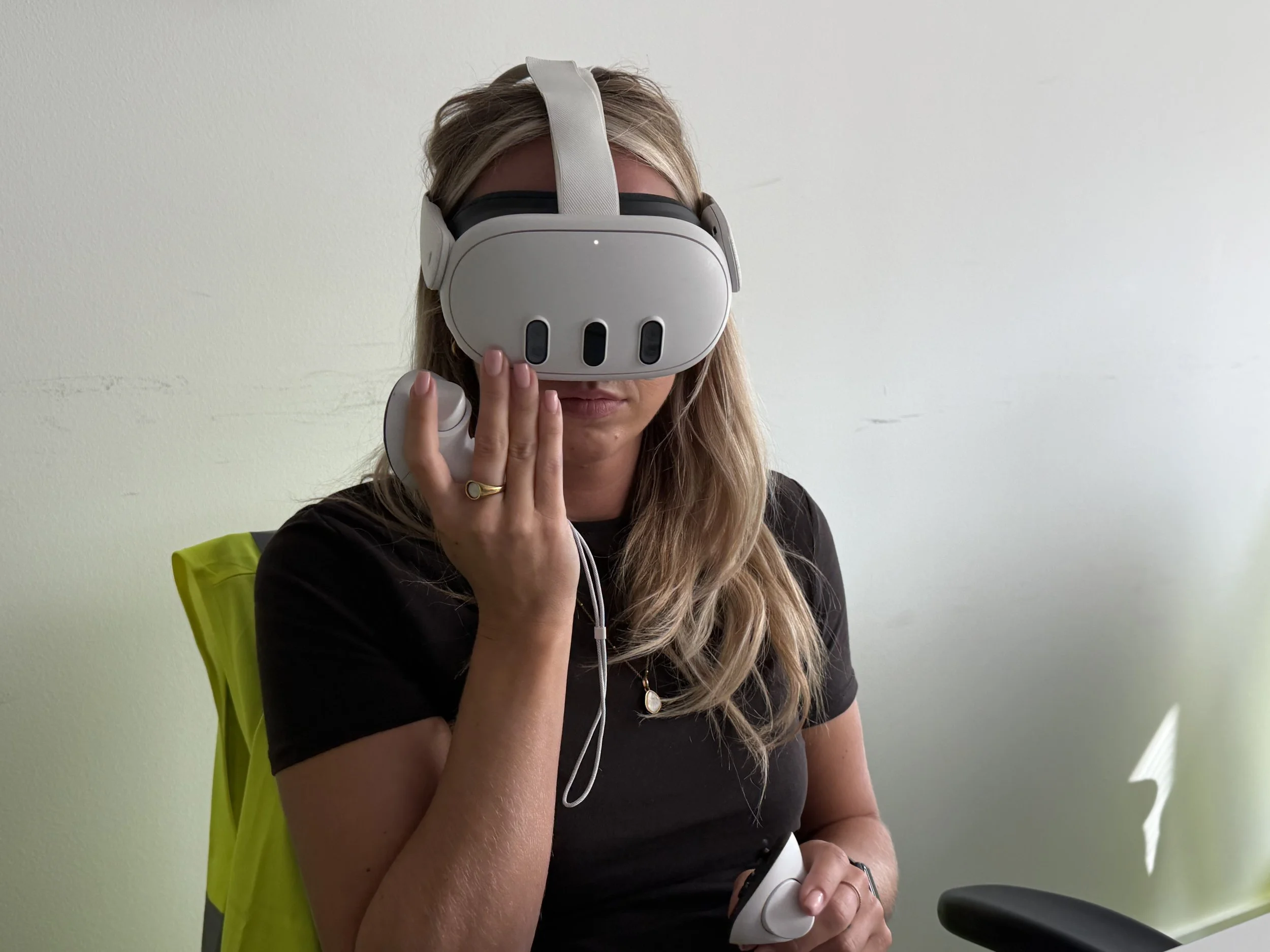
Learners using VR to explore risk, layout, fire precautions, and emergency scenarios in a controlled training environment.
Why VR matters in fire risk assessment training
Fire risk assessment is not just about learning legislation or memorising checklists. A competent assessor must observe, question, interpret, and decide. That is where many courses fall short. Learners can read guidance, sit in a classroom, and pass knowledge tests, yet still struggle when faced with a real building, real occupants, and real fire safety defects.
VR helps bridge that gap. It places the learner inside a realistic environment where they can move through spaces, identify hazards, review escape routes, look at fire doors, check housekeeping standards, and consider how people would respond in an emergency. This creates a more active learning process than static slides or classroom discussion alone.
Used properly, VR does not replace site experience. It strengthens it. It gives learners a structured way to practise before they step into live premises.
What VR can teach that a standard classroom often cannot
Traditional delivery is still important. Learners need the legal framework, the principles of fire development and spread, and an understanding of risk assessment methodology. But a slide deck cannot recreate the pressure of standing in an unfamiliar space and deciding what matters most.
VR allows learners to practise:
- spotting missed or hidden fire hazards
- reviewing means of escape from an occupant perspective
- recognising poor housekeeping and unsafe storage
- identifying weaknesses in compartmentation and fire doors
- considering who may be especially at risk
- making decisions where the answer is not obvious
- explaining findings clearly under tutor guidance
That matters because fire risk assessment is rarely a box ticking exercise. It depends on judgement. Judgement improves through structured exposure to realistic situations.
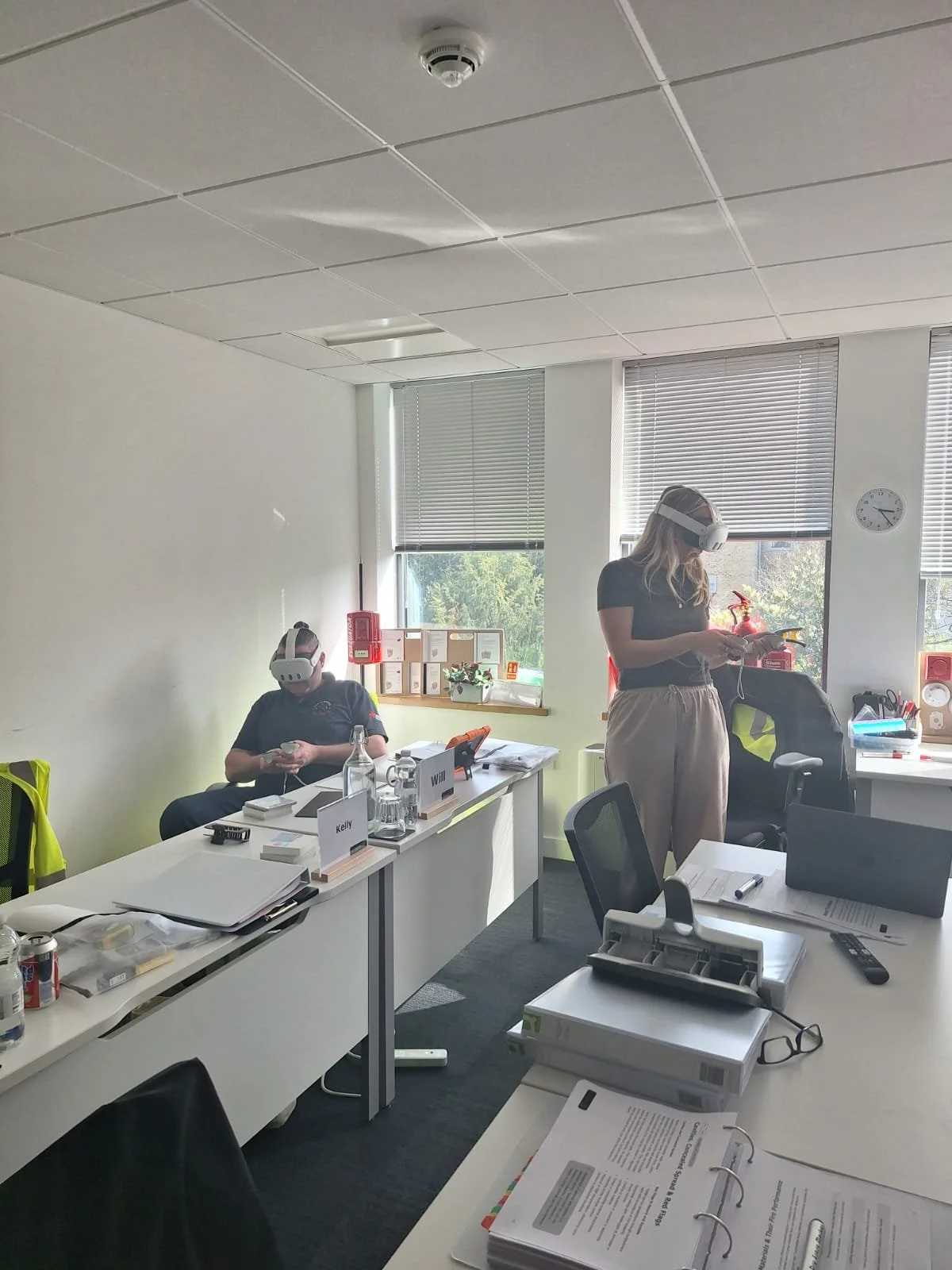
VR sessions can support discussion, observation exercises, and tutor led debriefs.
The value of immersion
One of the biggest strengths of VR is immersion. The learner is not simply looking at a photograph of a corridor or a still image of a staircase. They are placed inside an environment and must interact with it. They have to look up, down, behind doors, along routes, and around corners. That changes attention levels and often improves retention.
It also supports spatial awareness. In fire risk assessment, distance, travel direction, visibility, and the relationship between rooms and escape routes all matter. VR helps learners understand these issues in a way that flat images often cannot.
This is especially useful for new or developing assessors who have limited exposure to different building layouts and risk profiles.
VR should be used properly, not as a sales trick
There is a weak version of VR training and a strong version. The weak version is using headsets as a novelty. It may look modern, but it adds little if the scenario is shallow and the learning outcomes are vague.
The strong version is different. It is built around clear teaching aims. The tutor uses VR to test observation, prompt discussion, challenge assumptions, and connect what the learner sees back to legislation, guidance, and good practice. That is where the real value lies.
In other words, VR works best as part of a blended learning model. It should sit alongside tutor input, technical discussion, practical exercises, and structured feedback.
Examples of how VR can be used on a fire risk assessment course
A well designed VR session can expose learners to situations that would be difficult, disruptive, or unsafe to recreate in a live setting.
- walking through a building with poor housekeeping and blocked exits
- reviewing travel distances and final exit arrangements
- spotting defects in doors, signage, or emergency lighting
- assessing spaces used by vulnerable occupants
- testing decisions during a developing fire or evacuation scenario
- comparing good practice against poor practice in similar environments
That variety helps learners move beyond theory and into applied judgement.
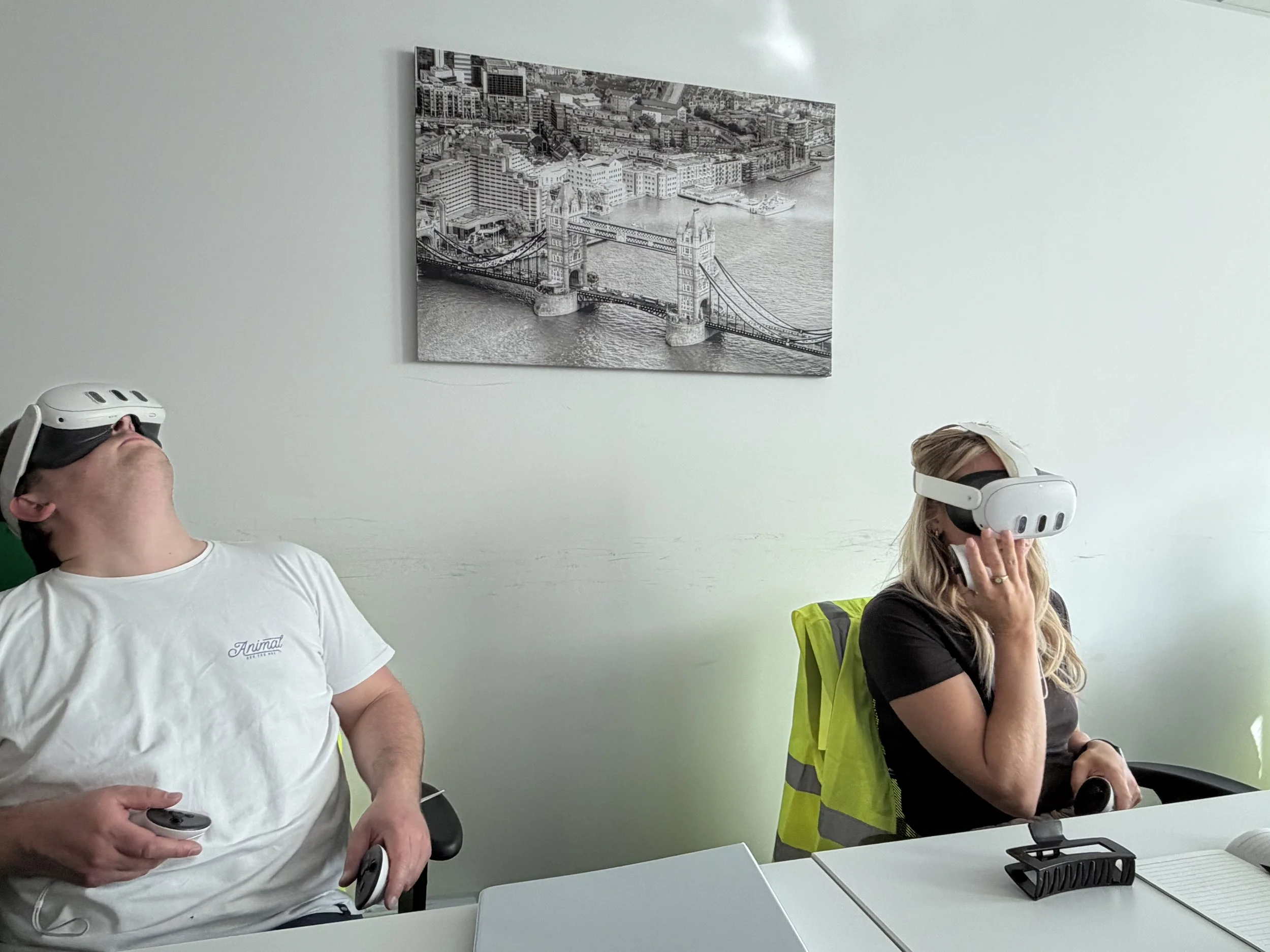
VR can form part of a wider tutor led session with discussion, debrief, and technical input.
What this means for learners
For learners, the main benefit is simple. VR gives you more practice before your judgement is tested in real settings. It helps turn passive learning into active learning. It also makes technical issues easier to understand because you can see them in context.
That can be particularly useful for people progressing into fire risk assessment from facilities management, health and safety, housing, estates, compliance, or operational fire safety roles. Many bring valuable experience, but they still need structured exposure to assessment scenarios.
VR can reduce that gap. Not by lowering standards, but by giving learners more chances to observe, think, and improve.
What this means for employers
Employers want more than certificates. They want people who can enter premises, notice what matters, and write sensible findings. That requires more than a theory course.
A course that includes VR can support stronger learner engagement and better practical understanding. It can also expose learners to a wider range of scenarios than a single site visit ever could.
That does not guarantee competence on its own. Competence still depends on training quality, assessment, supervision, and ongoing development. But VR can be a useful part of that pathway.
Our view at London Fire Consultants
At London Fire Consultants, we believe fire risk assessment training should be practical, credible, and rooted in real world application. Learners do not just need information. They need opportunities to apply it.
That is why VR can play a valuable role within a broader training model. When combined with tutor guidance, technical discussion, case based learning, and robust assessment, it helps learners build stronger observational skills and greater confidence.
The aim is not to impress learners with technology. The aim is to help them think more clearly, assess more carefully, and perform better in practice.
Looking for a fire risk assessment course with practical learning?
London Fire Consultants delivers fire risk assessment training designed to move beyond theory. Our courses are built to develop practical understanding, stronger judgement, and confidence in real world fire safety work.
If you want training that combines technical knowledge with applied learning, explore our courses or contact the team to discuss the right route for you or your organisation.
The Anatomy of a Fire Door
Fire Door Knowledge Hub
The Anatomy of a Fire Door
A practical guide to what makes up a fire door, how each part works, and why a fire door only performs when the complete assembly is specified, installed and maintained correctly.
A fire door is not just a door leaf
Many people think a fire door is just a thicker door with a label, a closer and some hinges. That view is wrong.
A fire door is a complete assembly. The leaf, frame, seals, glazing, hardware, threshold detail, surrounding structure and installation method all need to work together. If one part is wrong, the whole door can be compromised.
What is a fire door designed to do?
A fire door is there to resist the passage of fire and, where required, smoke when the door is closed. In real buildings, that means helping to maintain compartmentation, protecting escape routes, and limiting the spread of smoke through corridors, lobbies, stairways and shafts.
That is why fire doors matter so much. They are part of the building’s passive fire protection strategy. They buy time. They protect people. They help keep fire and smoke where they are supposed to be.
1. The door leaf
The door leaf is the moving part of the assembly. It is the part most people notice, but it tells only part of the story.
A leaf may be timber based, steel, composite or glazed metal. What matters is not just the material. What matters is whether that exact leaf forms part of a tested and evidenced fire door assembly. Thickness, construction, core type, lippings, edge details, cut outs and hardware preparation all matter.
A fire door leaf should never be treated as a standalone fire safety solution. It only performs as part of the full system it was designed for.
2. The frame
The frame is often overlooked. It should not be.
The frame holds the leaf, carries the hardware and forms the interface with the surrounding wall or partition. If the frame is the wrong size, wrongly fixed, poorly packed or badly sealed to the opening, the assembly can fail even if the leaf itself is in good condition.
The frame and the surrounding construction must be compatible. A fire door is only as reliable as the opening it is fixed into.
3. The seals
Seals are one of the most misunderstood parts of a fire door.
Intumescent seals expand when exposed to heat. Their job is to help close gaps and support fire resistance during a fire. Smoke seals are there to restrict the movement of smoke, often at ambient temperature before the intumescent material activates. Some systems combine both functions.
Missing seals, painted over seals, damaged seals or the wrong replacement seals can all undermine performance. This is one of the most common inspection failings.
4. The glazing
Vision panels are common in many fire doors. They improve visibility and can support safer movement through buildings. But glazing in a fire door is not ordinary glass in an ordinary opening.
The size, position and number of apertures matter. The glass type matters. The glazing beads, fixings, seals and retaining method matter. If someone cuts a new aperture on site without proper evidence and manufacturer guidance, they can take the door outside its proven scope.
A glazed fire door only performs when the glazing system is part of the tested and approved assembly.
5. The hardware
Hardware is not just decoration. It is critical.
Hinges, pivots, locks, latches, closers, panic hardware, coordinators, letter plates and air transfer grilles can all affect the way the fire door performs. Some items are essential to fire resistance. Others are not essential, but can still affect performance if added or replaced carelessly.
This is why swapping products on site because they “look the same” is poor practice. A hinge is not just a hinge. A closer is not just a closer. Compatibility matters.
Critical point
You cannot judge a fire door by one component. Performance belongs to the complete assembly, not to isolated parts.
6. The threshold and under door gap
The bottom edge of the door matters more than many people realise.
The threshold detail and the under door gap can affect smoke control, acoustic performance and overall fit. Some doors use drop seals. Others rely on different threshold arrangements. If the gap is excessive, the door may not perform as intended.
This is why floor finishes, later refurbishment and careless trimming at the bottom of the leaf can create serious problems.
7. The supporting evidence
This is the part many people skip. It is also the part that protects you when questions are asked.
A proper fire door should be backed by supporting evidence. That can include test reports, technical assessments, field of application reports and third party certification documents. The evidence should relate to the complete assembly, not a selective mixture of unrelated components.
If the paperwork does not show why the door is suitable for that exact use, confidence should be low.
8. The installation
Even a well specified fire door can be ruined by poor installation.
Incorrect fixings, poor frame alignment, unsuitable gap sealing, over trimming, damaged edges, badly fitted hardware and non compliant glazing can all affect performance. The installer needs to follow the manufacturer’s instructions and the supporting evidence, not site convenience.
Installation is not the easy bit. It is the bit where many otherwise sound specifications fail.
9. The maintenance
A fire door does not stay compliant just because it was right on day one.
Fire doors need ongoing inspection and maintenance. Hinges work loose. Closers fail. Seals get damaged. Glazing beads can deteriorate. Unauthorised alterations happen. If defects are not picked up and corrected, performance can be lost over time.
Maintenance is part of the anatomy too, because a neglected fire door is a failing fire door.
What should you look for during a basic visual check?
Leaf and frame
Check for damage, distortion, poor fit and unauthorised trimming.
Seals
Check they are present, continuous, undamaged and not painted over.
Hardware
Check hinges, latches and closers are secure and working correctly.
Self closing
Check the door closes fully into the frame and latches properly.
The real lesson
The anatomy of a fire door is not just timber, steel, seals and ironmongery.
It is specification, evidence, compatibility, installation and maintenance.
That is what separates a real fire door from a door that merely looks the part.
Need expert fire door advice?
London Fire Consultants provides independent fire door inspections, fire risk assessments, fire strategies and technical compliance advice.
If you need help reviewing fire doors in existing buildings or checking whether a proposed specification is evidence based, contact our team.
Frequently asked questions
Understanding Fire Certificates for Timber and Decorative Coatings
Knowledge Hub
Understanding Fire Certificates for Timber and Decorative Coatings
A practical guide to fire certificates for timber, decorative coatings, and fire retardant finishes. Learn what to check, what the classifications mean, and where specifications often fail.
The real issue is not whether a product has a certificate
When people ask whether a timber finish is fire rated, the question sounds simple.
It is not.
The real question is this. Does the exact product, on the exact substrate, in the exact build up, for the exact end use, have valid fire test evidence that matches the project requirement?
Why this matters
Many specification errors happen because designers, contractors, and clients rely on a brochure headline instead of the underlying evidence. A coating may have test data, but that does not automatically mean it is suitable for every timber surface, every density, every fixing arrangement, or every project.
That is how products end up on site which do not match the tested arrangement. Once that happens, the fire performance claim may no longer be defensible.
What people mean by “fire certificate”
The phrase fire certificate is used loosely across the construction industry. That is part of the problem. It can refer to several different documents, and those documents do not all do the same job.
Test report
Records what happened during a specific fire test on a specific sample.
Classification report
States the classification derived from the test evidence under the relevant standard.
Assessment or field of application
Explains how far the tested result may extend beyond the exact specimen tested.
Application guidance
Sets out how the product must be applied so the claimed performance can be relied on.
These documents are not interchangeable. Treating them as if they are creates risk.
Common mistake
A product brochure says the coating is “Class 0” or “B-s1,d0”. The team assumes that means the product can be applied to any timber surface and still achieve the same result. That assumption is often wrong.
Reaction to fire is not the same as fire resistance
This confusion appears regularly in product literature and on site.
For timber linings and decorative coatings, the issue is usually reaction to fire. That means how a material behaves when exposed to fire. It includes ignition, flame spread, heat release, smoke production, and flaming droplets.
Fire resistance is different. That relates to how long a building element can resist fire while maintaining functions such as loadbearing capacity, integrity, and insulation. If a supplier starts using fire resistance language to describe a decorative coating, you should look closely at what they are actually claiming.
Older BS 476 language still causes confusion
Many people still use terms such as Class 0 and Class 1. Those references remain common in the market, especially for legacy products and older specifications.
The problem is that some teams then try to compare those results directly with Euroclass ratings. That can be misleading. Different standards, different test methods, and different classification systems are involved.
If your project requires compliance with current regulatory expectations, do not rely on a simple comparison table without checking whether the exact evidence route is still suitable for the actual application.
What you must check before accepting a fire performance claim
1. Exact product identity
Check the exact product name, manufacturer, and coating system. Do not assume similar products perform the same way.
2. Substrate type
Confirm the species, density, thickness, and surface condition of the timber or board. Fire performance often depends on these factors.
3. Surface condition
Was the tested specimen bare timber, veneered board, factory coated board, or a surface with joints and gaps? Small differences can matter.
4. Application rate and thickness
Check the declared dry film thickness, wet film thickness, coverage rate, and number of coats. The claimed result may only apply at the tested loading.
5. End use
Is the product proposed for a wall, ceiling, soffit, joinery item, or another application? Do not assume one tested use automatically covers another.
6. Limitations
Read the full report for restrictions, exclusions, warnings, and assumptions. The limitations section is often the most important part.
How Euroclass ratings are commonly presented
Euroclass ratings are often shown as a combination of letters and suffixes. For example, B-s1,d0.
| Element | What it indicates |
|---|---|
| B | The main reaction to fire class for the tested product or system |
| s1 | Lower smoke production than s2 or s3 |
| d0 | No flaming droplets or particles within the criteria of the test classification |
The critical point is this. You must read the whole classification, not just the headline letter.
A better question to ask suppliers
Do not ask only whether the product is fire rated.
Ask this instead.
Can you provide the classification report, test basis, field of application, and application instructions which prove this exact product is suitable for this exact substrate and this exact end use?
Where projects usually go wrong
- The team relies on a sales brochure instead of the full technical evidence
- The product was tested on a different timber density or board type
- The applied coating thickness on site does not match the tested build up
- The report includes limitations which no one has read
- Old classification language is used without checking whether it is still suitable for the project route
- A result for one arrangement is assumed to apply to every arrangement
The safest approach
Start with the project requirement.
Then work backwards.
What class is required for the relevant application. What substrate is proposed. What coating system is proposed. What evidence proves that the exact combination complies.
If the evidence chain breaks at any point, the claim should be challenged before the product reaches site.
How London Fire Consultants can help
At London Fire Consultants, we review fire performance claims critically. We do not treat a certificate title as proof. We assess the underlying evidence, the classification route, the substrate, the tested build up, the project use, and the limitations.
That helps clients reduce specification risk, avoid poor assumptions, and make decisions that are easier to justify.
Need an independent review of timber coating fire evidence or a proposed specification? Contact London Fire Consultants.
LEVEL 3 FIRE RISK ASSESSOR COURSE
A clear guide to the ProQual Level 3 Award in Fire Risk Assessment.
Learn who the course is for, what it covers, how it is assessed, and why it gives new and developing fire risk assessors a strong regulated starting point.
Level 3 Fire Risk Assessor Course. A practical starting point for people who need a regulated route into fire risk assessment.
If you are new to fire risk assessment, or you need a recognised foundation before moving into more advanced work, the ProQual Level 3 Award in Fire Risk Assessment gives you a structured and credible place to begin.
Choosing a fire risk assessor course is not just about finding something with a certificate at the end. You need to know what level it sits at, whether it is regulated, how it is assessed, and whether it actually matches your stage of development.
The ProQual Level 3 Award in Fire Risk Assessment is positioned as a foundation route for low risk premises. It is designed for new and developing fire risk assessors, responsible persons, managers, compliance staff, and others who need a structured introduction before progressing further.
Who this course is for
This course is built for people who need a formal foundation in fire risk assessment. It is best suited to those at the start of their development, not people already operating at complex or high risk building level.
- New and developing fire risk assessors
- Responsible persons who want structured knowledge
- Managers and compliance staff with fire safety duties
- People who want a regulated starting point before Level 4
- Learners who need a course focused on low risk premises
What you actually learn on the Level 3 fire risk assessor course
A weak course gives you isolated facts. A stronger course gives you a framework. This qualification contains three mandatory units and is described as covering a foundation introduction to fire risk assessment, fire development and spread, and managing fire risk.
Fire risk assessment fundamentals
You develop an understanding of the principles, procedures, and legislation behind fire risk assessment. This helps you see how an assessment is structured and why recommendations need to be evidence led.
Fire development and spread
Good assessors need more than a checklist mindset. They need to understand how fires develop, how smoke and heat spread, and what that means for life safety measures in real buildings.
Managing fire risk
The course also covers the management side of fire safety, helping learners understand what proportionate control measures look like in low risk premises.
Progression thinking
This is not presented as an endpoint for complex practice. It is a foundation route aligned to BS 8674:2025 with a defined progression path into Level 4.
How the course is assessed
The qualification is portfolio based. There is no written examination listed on the live course page. Learners complete structured learning across the mandatory units and build evidence through assignments and applied assessment activity, with tutor feedback, internal assessment, and external quality assurance.
This matters because attendance alone does not prove competence. A portfolio route creates more space for structured feedback, written development, and evidence against the qualification requirements.
Entry expectations
The live course information states that there are no formal academic entry requirements. Even so, this is not a casual enrolment. You need to be at least 18, able to complete written work in English to a professional standard, and have access to a context where you can review fire risk assessment in a low risk building.
What happens after Level 3
The stated progression route is into the ProQual Level 4 Certificate in Fire Risk Assessment for learners whose experience and scope support that next step. That is a more honest positioning than pretending one short course makes someone ready for every building type.
Why some buyers choose this course over larger providers
Buyers usually care about four things. Is the qualification regulated. Is the tutor credible. Will they get support. Will the course actually help them progress. The live course page leans heavily into those points.
Regulated qualification
This is presented as an Ofqual regulated ProQual qualification on the Regulated Qualifications Framework.
Named tutor
The course is led by Simon Tudor, whose published profile describes him as founder of London Fire Consultants, a Tier 3 IFSM Registered Fire Risk Assessor, BAFE SP205 Validator, and specialist trainer with broader fire safety credentials.
Small cohorts
The page states a maximum of five learners. That gives a very different learning environment from large volume delivery models.
Clear progression
The course is explicitly positioned as a foundation route into Level 4, not as a shortcut to high risk or complex premises work.
Common questions about the Level 3 fire risk assessor course
Is this an Ofqual regulated qualification?
Can I complete the course online?
Does this course qualify me to assess complex or high risk premises?
What is the main practical value of this course?
Is this the right fire risk assessment course for you?
If you are completely new to fire risk assessment and need a regulated foundation, this is the right sort of course to consider. If you already have meaningful experience and want to move into intermediate practice, you should test whether Level 4 is the better fit instead.
That is the real question. Not which page sounds best. Which qualification genuinely matches your current level and intended scope of work.
Need a recognised starting point in fire risk assessment?
The ProQual Level 3 Award in Fire Risk Assessment is designed for learners who want a regulated foundation, direct tutor support, and a clear route into further development.
ProQual’s New Fire Risk Assessment Qualifications - What the New Suite Means for Learners, Employers and the Fire Safety Sector
ProQual’s new fire risk assessment qualifications create a clearer progression route for learners and employers. This article explains the Level 3 Award, Level 4 Certificate, Level 5 Award and Level 5 Diploma in Fire Risk Assessment, including entry expectations, assessment methods and what the new suite means for professional competence in the fire safety sector.
Fire Safety Blog
ProQual’s New Fire Risk Assessment Qualifications
What the new qualification suite means for learners, employers and the fire safety sector
Published 1 April 2026
ProQual’s revised fire risk assessment qualifications create a clearer route from foundation level learning through to advanced fire risk assessment practice. The new suite includes a Level 3 Award in Fire Risk Assessment, Level 4 Certificate in Fire Risk Assessment, Level 5 Award in Fire Risk Assessment and Level 5 Diploma in Fire Risk Assessment. For learners and employers, that means a more structured and easier to understand pathway into the profession.
The fire risk assessment qualification landscape has changed. ProQual now offers a more coherent progression route for those entering or advancing in the field of fire risk assessment. The new suite replaces older titles that caused confusion across the market and sets out a clearer pathway from introductory knowledge to intermediate practice and then to more advanced work associated with higher risk buildings.
That change matters. Learners need to know where to start and what comes next. Employers need qualifications that are easier to understand, easier to compare and easier to align with the types of premises their staff are expected to assess. A clear qualification structure helps both sides make better decisions.
The new ProQual fire risk assessment pathway
The starting point is the ProQual Level 3 Award in Fire Risk Assessment, qualification number 610/7041/5. This qualification is aligned to the foundation fire risk assessment competencies in BS 8674:2025. It is designed to introduce the key principles, procedures and legislation relevant to fire risk assessment and to prepare candidates to undertake and report on fire risk assessments in lower risk settings.
There are no formal academic entry requirements at Level 3. That said, candidates still need access to a role or training programme that allows them to review fire risk assessment practice in a low risk building. This is important because even at foundation level, fire risk assessment should not be treated as abstract theory detached from real premises and real decisions.
The next step is the ProQual Level 4 Certificate in Fire Risk Assessment, qualification number 610/7056/7. This qualification is aligned to the intermediate fire risk assessment competencies in BS 8674:2025. It includes five mandatory units and covers intermediate fire risk assessment practice, low risk buildings, moderate risk buildings and professional development.
Entry at Level 4 is aimed at candidates who either hold the Level 3 Award in Fire Risk Assessment or can demonstrate at least three years of relevant occupational experience in fire risk assessment. That threshold matters because Level 4 is not simply more content. It requires stronger judgement, broader technical understanding and a higher standard of application.
At advanced level, ProQual has introduced two linked qualifications. The ProQual Level 5 Award in Fire Risk Assessment, qualification number 610/7065/8, provides a smaller route for focused progression at advanced level. The ProQual Level 5 Diploma in Fire Risk Assessment, qualification number 610/7064/6, is the broader qualification intended for more extensive advanced development.
Both Level 5 qualifications have been developed in line with BS 8674:2025. They are intended to build on earlier competence, support continuing professional development and prepare candidates to lead and undertake fire risk assessments in more complex or higher risk premises. In practical terms, Level 5 is where greater professional judgement, deeper technical understanding and more advanced decision making become central.
What the entry expectations mean in practice
The entry expectations become more demanding as candidates move through the suite. That is exactly what should happen in a credible professional framework. Candidates progressing to Level 5 should normally hold the Level 4 Certificate in Fire Risk Assessment, an equivalent qualification, or have at least five years of demonstrable occupational experience carrying out fire risk assessments.
Candidates at this level also need access to a role or training programme that allows them to carry out fire risk assessment simulations for low, moderate and advanced risk buildings. That point should not be overlooked. Advanced fire risk assessment should not be treated as a theory only exercise. It is supposed to reflect higher level professional judgement and practical application.
Why the assessment model matters
One of the strengths of the new ProQual suite is the assessment model. Across the current Level 3, Level 4 and Level 5 fire risk assessment qualifications, assessment is carried out through centre based delivery supported by internal assessment, internal verification and external quality assurance.
Candidates are required to build a portfolio of evidence. Depending on the level, that evidence may include assignments, projects, reports, professional discussion, candidate products, worksheets, oral questioning, written questioning and recognition of prior learning where appropriate.
That is a stronger model than a simple attendance certificate. It requires evidence against defined learning outcomes and assessment criteria. For employers, that provides greater assurance. For learners, it creates a more credible basis for progression and professional recognition.
What this means for employers
For employers, the commercial and operational value is clear. A staged qualification pathway makes workforce planning easier. New entrants can begin at Level 3. Practitioners working at intermediate level can move to the Level 4 Certificate. More experienced assessors working with complex or higher risk premises can progress to Level 5.
That structure is easier to explain internally and easier to benchmark against competence frameworks, quality systems and client expectations. It also makes it easier to match a qualification to the level of risk that an assessor is expected to deal with in practice.
What this means for learners
For learners, the message is straightforward. Do not choose a fire risk assessment qualification based on marketing language alone. Check the exact qualification title. Check the qualification number. Check the level, the entry expectations, the assessment model and the type of buildings the qualification is intended to support.
The current ProQual suite makes those checks easier because the route from foundation through to advanced practice is now more clearly defined. That does not remove the need for judgement, experience or ongoing development. It does, however, give the market a better structure to work with.
Choosing the right level
The real question is no longer simply which course looks best on a website. The better question is which qualification level matches the type of premises you assess now, the type of premises you want to assess next and the level of responsibility you are ready to hold.
ProQual’s new fire risk assessment qualifications give learners, employers and training providers a clearer answer to that question. For a sector that has often struggled with inconsistent terminology and mixed market messaging, that is a significant step forward.
Need help choosing the right fire risk assessment qualification?
Explore the Fire Safety College prospectus, compare the Level 3, Level 4 and Level 5 routes, and choose the qualification that matches your experience and the type of buildings you assess.
Frequently Asked Questions about Fire Risk Assessor Training with The Fire Safety College
Fire Risk Assessor Training FAQs from The Fire Safety College at London Fire Consultants. Find answers on Level 3, Level 4 and Level 5 fire risk assessor courses, BS 8674 competence, third party certification, accreditation, and how to choose the right fire risk assessment training route.

Proqual Logo
The Fire Safety College is the training arm of London Fire Consultants. The Fire Safety College sits within a wider business that also offers fire risk assessments, fire consultancy, fire door inspections, extinguisher services, and broader fire safety support.
London Fire Consultants promotes fire risk assessor training alongside its wider fire safety services. That structure gives learners a clearer link between training, competence, and practical fire safety work.
Contents of the Frequently Asked Questions
Why choose The Fire Safety College
Fire risk assessor course pathway
BS 8674 and competence
Third party certification and trust
About Simon Tudor
Fire Risk Assessor Training FAQs
Choose the right fire risk assessor course
Why choose The Fire Safety College
The Fire Safety College combines training with the broader technical background of London Fire Consultants. London Fire Consultants offers fire risk assessments, consultancy, fire door inspections, extinguisher services, and additional fire safety support, which gives the training offer a stronger practical context than a stand alone course page.
The Fire Safety College also sits alongside a public emphasis on competence, recognised course pathways, and third party certification. That combination is one of the strongest trust signals on the current site.
Training delivered through The Fire Safety College
Part of a wider fire safety consultancy business
Clear route into fire risk assessor development
Strong emphasis on competence and course level
Supported by third party certification and accreditation
Fire risk assessor course pathway
London Fire Consultants currently highlights three fire risk assessor training routes on the homepage. The current pathway shown on the live site is Level 3 Award in Fire Risk Assessment Foundation, Level 4 Certificate in Fire Risk Assessment Intermediate, and Level 5 Diploma in Fire Risk Assessment Advanced.
That current three level pathway is the safest wording to use on the website because it matches the live homepage and avoids mixing in older or different qualification naming from other pages or articles. This matters for clarity, user trust, and AI retrieval.
Current pathway focus
Level 3 Award in Fire Risk Assessment Foundation
Level 4 Certificate in Fire Risk Assessment Intermediate
Level 5 Diploma in Fire Risk Assessment Advanced
Course selector to help learners choose the right route
Training formats
E learning
Face to face training
Blended learning
BS 8674 and competence
BS 8674:2025 provides a recognised benchmark for the competence of individual fire risk assessors. The strongest website safe message is that the right course depends on the learner’s current competence and the type of premises they intend to assess.
That is the right commercial and technical message to publish. A learner who needs foundation level knowledge should not be pushed toward an advanced route too early, and a learner who intends to assess more complex premises needs a route that reflects that higher level of competence. This wording is safer than making broader claims that the current homepage does not spell out in detail.
Third party certification and trust
Third party certification is one of the strongest credibility signals on the London Fire Consultants website. The accreditations page presents UKAS BAFE SP205 and SSAIB, and the site also points users toward further information on third party accreditation.
That matters because third party certification gives users a clearer basis for trust than unsupported marketing claims alone. On the live site, accreditation is one of the clearest public proof points and should stay central in homepage copy.
Third party certification as an independent quality signal
UKAS BAFE SP205 publicly listed
SSAIB publicly listed
Further accreditation information available on the site
About Simon Tudor
Simon Tudor is presented on the site as the founder of London Fire Consultants. The About Us page also links Simon Tudor to a background that includes Ministry of Defence service and training at the Fire Service College, Warsash Fire Fighting School, and BRE at Watford.
The About Us page also links Simon Tudor to work across multiple organisations and states that he has been interviewed by Channel 5 as a fire safety expert. For the homepage, that section should stay brief and factual rather than trying to duplicate the full About Us page.
Fire Risk Assessor Training FAQs
What is The Fire Safety College?
The Fire Safety College is the training arm of London Fire Consultants. The Fire Safety College sits within a wider fire safety business that also provides fire risk assessments, consultancy, fire door inspections, extinguisher services, and specialist support.
Does The Fire Safety College offer fire risk assessor training?
Yes. London Fire Consultants highlights fire risk assessor training routes on the homepage and provides a course selector to help learners choose the right course.
What is the difference between Level 3, Level 4, and Level 5 fire risk assessor courses?
The homepage presents the pathway as Level 3 Award in Fire Risk Assessment Foundation, Level 4 Certificate in Fire Risk Assessment Intermediate, and Level 5 Diploma in Fire Risk Assessment Advanced. That structure gives learners a clearer progression route rather than a one size fits all course.
Why does competence matter when choosing a fire risk assessor course?
Competence matters because the right course depends on the learner’s current level and the type of premises they need to assess. A clear course pathway helps learners choose a route that is proportionate to their knowledge and intended scope of work.
Why does third party certification matter when choosing a fire safety provider?
Third party certification matters because it is one of the clearest public trust signals on the site. Accreditation gives users an external basis for confidence rather than relying only on self description.
What accreditations does London Fire Consultants list?
London Fire Consultants lists UKAS BAFE SP205 and SSAIB on its accreditations page. The homepage also links to further information on third party accreditation.
Who leads London Fire Consultants and The Fire Safety College?
Simon Tudor leads London Fire Consultants and is identified on the About Us page as the founder of the business. The About Us page also summarises his fire safety background and training.
Choose the right fire risk assessor course
The right fire risk assessor course depends on your current competence, your intended scope of work, and the type of premises you need to assess. Use the live course pathway and course selector to identify the route that best fits your level.
How to Select a Fire Risk Assessor Course
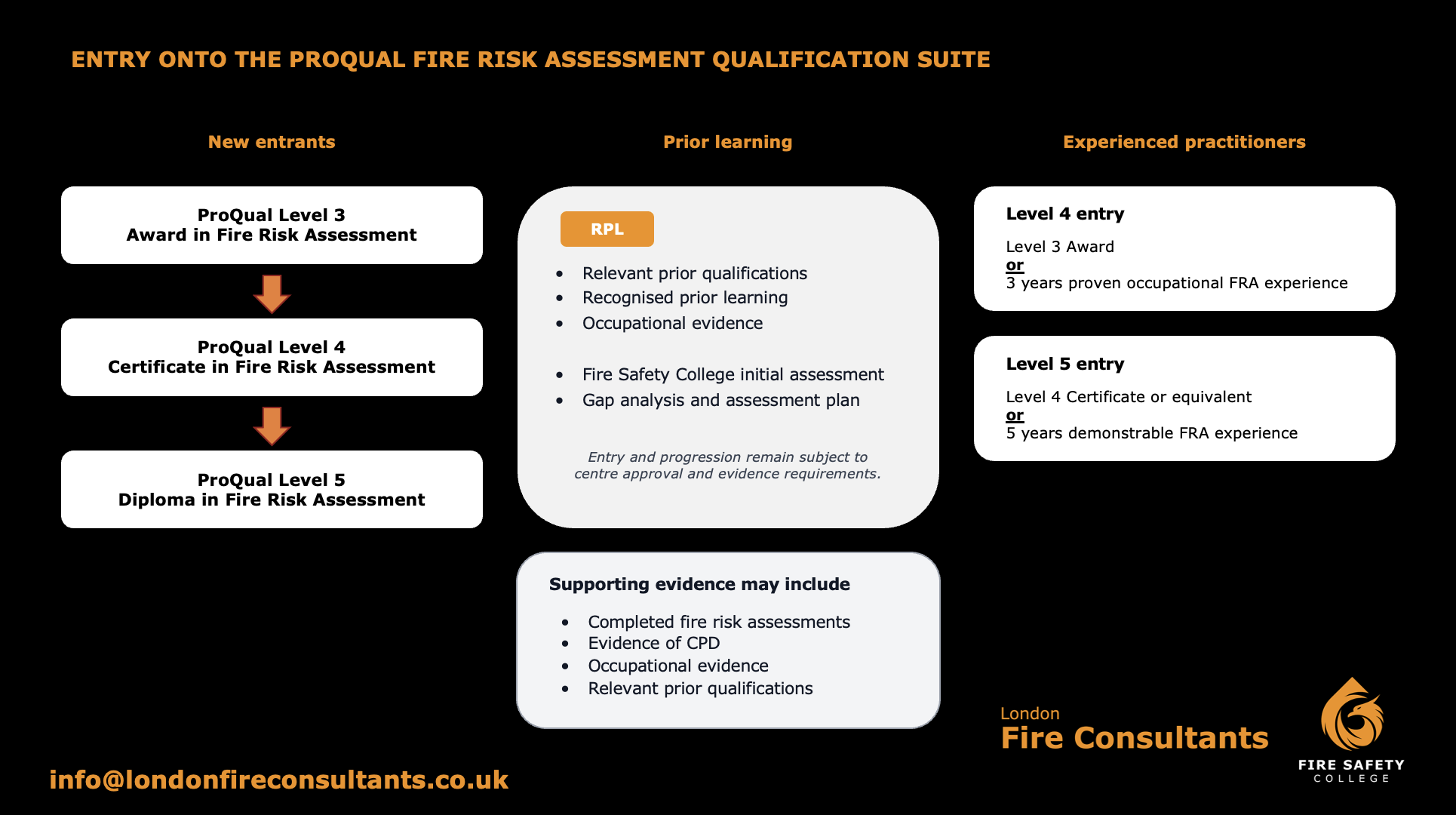
Choosing a fire risk assessor course is not as simple as picking the cheapest option, the shortest course or the provider with the loudest marketing. The real question is whether the course matches your current level of knowledge, your actual experience and the type of premises you intend to assess. That is where many people go wrong. They assume a single qualification can make them competent for every building type. It cannot. Fire risk assessment competence is not one size fits all. A course for a new entrant should not be sold as though it automatically prepares someone for complex or high risk buildings. Equally, an experienced practitioner should not be forced into a route that ignores prior learning, occupational evidence and existing competence. The better approach is to choose a course that fits where you are now and where you realistically need to get to.
The ProQual fire risk assessment qualification suite is structured in a way that reflects that progression. For new entrants, the route begins with the ProQual Level 3 Award in Fire Risk Assessment, progresses to the ProQual Level 4 Certificate in Fire Risk Assessment and then to the ProQual Level 5 Diploma in Fire Risk Assessment. For learners with prior learning or occupational evidence, recognition of prior learning can be considered alongside an initial assessment and gap analysis. For experienced practitioners, direct entry may be possible. The Level 4 Certificate is intended for those who already hold the Level 3 Award or who have at least three years of proven occupational fire risk assessment experience. The Level 5 Diploma is aimed at those who already hold the Level 4 Certificate or equivalent, or who can demonstrate at least five years of occupational fire risk assessment experience. That structure matters because it avoids the fiction that everyone should start in the same place.
A sensible course selection process should start with honesty. What premises have you actually assessed. What level of responsibility have you held. Can you explain your methodology. Can you recognise the limits of your competence. Have you completed defensible fire risk assessments, or have you mostly followed templates and repeated what previous reports said. Those questions are more useful than asking which course sounds the most advanced. In practice, a learner with little or no meaningful experience is far better served by a solid Level 3 foundation than by being pushed too quickly into a higher level course they are not ready for. The Level 3 Award is aligned to BS 8674:2025 foundation competencies and provides a nationally recognised introduction to the principles, procedures and legislation of fire risk assessment. It has 100 hours total qualification time, 60 guided learning hours and three mandatory units covering foundation fire risk assessment, fire development and spread, and the management of fire risk.
The next step is to look closely at what each qualification is actually designed to do. The Level 4 Certificate is not simply more of the same. It is aligned to intermediate fire risk assessment competencies and is designed to build foundation and intermediate competence. It covers low risk and moderate risk buildings, evaluation of fire risk assessment materials, current legislation, simulated low risk fire risk assessments, the management of fire risk in moderate risk buildings and personal development as a fire risk assessor. It is also significantly larger than the Level 3 Award, with 245 total qualification hours and 160 guided learning hours across five mandatory units. That tells you something important. Progression is not just about collecting certificates. It is about moving into more demanding assessment work with broader technical expectations and greater professional judgement.
The same principle applies again at Level 5. The ProQual Level 5 Diploma in Fire Risk Assessment is aimed at advanced practice in high risk buildings. It is aligned to BS 8674:2025 and designed for those who want to lead and undertake fire risk assessments in high risk premises. It includes high risk building assessment, management of fire risk in high risk buildings, advanced fire risk assessment and professional development as an advanced fire risk assessor. This is not a casual next step for someone who has not yet mastered lower and moderate risk work. It is a substantial qualification with 380 total qualification hours and 260 guided learning hours. Anyone choosing a course should be wary of training providers who blur these boundaries and imply that a quicker or higher sounding course will solve competence gaps. It will not.
Another issue to examine is entry requirements. A credible provider should not treat them as optional. Entry requirements exist for a reason. The Level 4 Certificate states that candidates should hold the ProQual Level 3 Award in Fire Risk Assessment or have at least three years of proven occupational experience in the field. The Level 5 Diploma states that candidates should hold the ProQual Level 4 Certificate or equivalent qualifications, or have at least five years of demonstrable occupational experience conducting fire risk assessments. That is not gatekeeping for the sake of it. It is a basic control against overreach. If a provider is willing to wave everyone straight through without properly assessing prior qualifications, occupational evidence and learning needs, that should concern you.
This is where a robust initial assessment matters. A proper training provider should not just ask what qualification you want. They should assess your current position. That may include prior qualifications, recognised prior learning, occupational evidence, completed fire risk assessments and evidence of continuing professional development. A gap analysis and assessment plan should follow. That approach is more rigorous, but it is also more defensible. It helps prevent a learner being placed on the wrong course and makes it easier to identify what support, experience or evidence is needed for progression. If you are serious about becoming competent, that is the process you should want.
You should also examine how the course is assessed. Weak training often relies too heavily on attendance or simplistic knowledge checks. Stronger qualifications require evidence. The ProQual specifications make clear that candidates are expected to produce portfolios of evidence and, at Levels 4 and 5, to complete competency based tasks supported by assessor observation, photographic or video evidence, witness testimony and candidate reflection where appropriate. That matters because fire risk assessment is not just about what you can repeat in a classroom. It is about whether you can apply knowledge, make sound decisions, communicate findings and justify recommendations.
The provider itself also matters. You are not just choosing a syllabus. You are choosing who will shape your understanding of the role. A good provider should be able to explain where each course sits, what it does and does not prepare you for, and how it aligns with a wider competence framework. They should also be realistic about scope. No credible provider should suggest that completion of one course automatically makes you competent to assess every premises. Fire risk assessment requires qualifications, yes, but also experience, judgement, supervision, reflection and an understanding of your own limits. Any provider who skips that message is selling comfort, not competence.
At The Fire Safety College, our view is simple. Start at the right level. Progress for the right reasons. Use evidence, not ego, to decide your route. For new entrants, that often means beginning with the Level 3 Award and building properly from there. For those with relevant prior learning or occupational evidence, recognition of prior learning and initial assessment may support a different entry point. For experienced practitioners, progression to Level 4 or Level 5 should still be based on demonstrable evidence, not assumption. That approach is stricter, but it is also more honest and more consistent with the realities of fire risk assessment practice.
If you are selecting a fire risk assessor course, do not just ask which one is best. Ask which one is right for your current competence, your evidence base and the type of premises you need to assess. That is the question that protects your credibility and, more importantly, the people who rely on competent fire risk assessment.
ProQual Level 5 Diploma in Fire Risk Assessment
Why this qualification matters
The fire sector talks a great deal about competence, but the harder question is this. Competence to do what, and in what type of building?
That distinction matters. A person may be capable in lower risk premises and still not be competent to lead a fire risk assessment in a high risk building. The ProQual Level 5 Diploma in Fire Risk Assessment is designed for that higher level of practice. It is a nationally recognised, Ofqual regulated qualification aligned to BS 8674:2025 and intended for those who want to develop advanced competence in fire risk assessment. Its focus is not basic awareness. Its focus is leading, managing and reporting on fire risk assessments in high risk premises.
What the Level 5 Diploma is designed to do
The qualification has been developed to build on foundation and intermediate fire risk assessment competence. It is aimed at those who want to progress into more advanced work and take on greater responsibility in complex or high consequence settings. According to the specification, its aims are to build on intermediate and foundation competencies, prepare candidates for leading and undertaking fire risk assessments for high risk premises, and promote continuous professional development and the sharing of best practice in the field of fire risk assessment.
That point is important. This is not simply a longer course with a higher number attached to it. It is a qualification built around a different level of judgement, responsibility and technical demand. High risk buildings bring more complexity, more consequence and less margin for error. A superficial understanding of fire safety is not enough. The assessor needs to be able to analyse risk properly, challenge assumptions, communicate clearly and produce defensible outcomes.
Who the course is for
The ProQual Level 5 Diploma in Fire Risk Assessment is intended for experienced practitioners. The learner profile states that candidates should either hold the ProQual Level 4 Certificate in Fire Risk Assessment or equivalent qualifications, or have at least five years of demonstrable occupational experience conducting fire risk assessments. Candidates must also be in a role or on a training programme that gives them the opportunity to carry out fire risk assessment simulations for low, moderate and advanced risk buildings.
That entry profile is sensible. One of the biggest problems in the sector is overreach. Too many people assume that a bit of experience or a shorter qualification automatically makes them suitable for advanced work. It does not. This diploma is for those who already have a solid base and are ready to operate at a more demanding level.
What the qualification covers
The ProQual Level 5 Diploma in Fire Risk Assessment consists of four mandatory units:
Undertaking a Fire Risk Assessment for High Risk Buildings
Managing the Risk of Fire in High Risk Buildings
Advanced Fire Risk Assessment
Professional Development as an Advanced Fire Risk Assessor
Taken together, these units are designed to move the learner beyond basic inspection and reporting. They address the practical undertaking of high risk fire risk assessments, the technical and specialist issues that influence fire safety, the production and leadership of advanced fire risk assessment work, and the ongoing professional development expected of an advanced assessor.
The specification also makes clear that this qualification is substantial. It has a total qualification time of 380 hours and 260 guided learning hours. That alone tells you this is not a lightweight bolt on. It is a serious commitment for serious practitioners.
A closer look at the advanced level
The unit content gives a better sense of what makes this a Level 5 qualification.
In the unit on undertaking a fire risk assessment for a high risk building, learners are expected to plan, lead and report on a simulated fire risk assessment for a high risk building. This includes examining internal and external structure, considering compartmentation and external walls, addressing all fire safety concerns, evaluating intolerable risk and producing an effective plan for immediate action. They must also demonstrate leadership in the dissemination of findings and critically evaluate their own performance and organisational procedures.
That is materially different from simply spotting common defects and writing a list of actions. It is about leadership, judgement and the ability to handle difficult outcomes.
In the unit on managing the risk of fire in high risk buildings, learners deal with cultural, technical and specialist factors that influence fire safety. This includes the effect of social, economic and business factors, the evaluation of external wall systems, the interaction of building materials and installed systems, recognition of when an FRAEW is required, and identification of situations where fire life safety risks are so serious that evacuation may be necessary. The unit also requires critical evaluation of fire strategies and the presentation of fire engineering solutions where standard guidance cannot feasibly be applied.
Again, this is where weaker training often falls apart. It is easy to repeat guidance. It is harder to know when guidance is insufficient, when specialist input is needed, and how to frame recommendations without drifting outside competence.
The advanced fire risk assessment unit expects learners to lead the production of fire risk assessments for high risk buildings, analyse complex resources, implement research into reporting, resolve challenging risk situations with compliant solutions, and communicate complex outcomes to stakeholders in ways that influence decision making and compliance. It also goes further by requiring contribution to the wider development of fire risk assessment practice, including participation in working groups, improving methodologies and even involvement in specification, tendering and procurement of fire safety systems.
That is a strong indicator of the level this qualification is pitched at. It is not just about individual inspections. It is about wider professional contribution and leadership across the fire risk assessment process.
Assessment and evidence
The diploma is assessed through a portfolio of evidence. The specification lists evidence types such as assignments, projects, reports, professional discussion, candidate product, worksheets, oral and written questioning, and recognition of prior learning. It also makes clear that some units are competency based and require more than written answers. Expected evidence includes photographic or video evidence of practical work, assessor observation reports, expert witness testimony and candidate reflection.
That matters because good fire risk assessment is not purely theoretical. A learner may be able to talk about compartmentation, external walls or specialist systems, but the more important question is whether they can apply that knowledge in a structured and defensible way. The qualification appears to recognise that distinction.
Why employers and clients should care
From an employer or client perspective, the value of this qualification is not that it acts as a magic badge. No qualification can do that. The value is that it gives a structured, regulated route for experienced practitioners to evidence development towards advanced competence in high risk fire risk assessment.
In a sector under growing scrutiny, that has real weight. Clients are increasingly asking harder questions. Duty holders are under more pressure. The consequences of poor advice are more visible than ever. A regulated Level 5 diploma aligned to BS 8674:2025 gives a far stronger foundation than vague claims of expertise or attendance only training.
That said, the qualification should not be oversold. A diploma does not remove the need for judgement, ethics, scope control or ongoing learning. It should be seen as part of competence, not the whole of it. The best practitioners know that qualifications matter, but so do experience, supervision, critical reflection and the discipline to recognise when a matter needs specialist support.
Why study with The Fire Safety College
At The Fire Safety College, we believe advanced fire risk assessment training should be rooted in the real demands of practice. That means training must be technically credible, properly structured and honest about the limits of competence as well as the value of progression.
The ProQual Level 5 Diploma in Fire Risk Assessment is an important qualification for those who want to move into advanced fire risk assessment work. It provides a structured path for experienced practitioners who want to strengthen their capability in high risk premises, improve the quality of their reporting and decision making, and develop as leaders in the field.
For those ready to step beyond intermediate level work, this qualification offers a robust next stage.
If you are looking to develop advanced fire risk assessment competence through a recognised and regulated route, The Fire Safety College can support you through the ProQual Level 5 Diploma in Fire Risk Assessment.
BS 8214:2026 Has Arrived. What It Means for Fire Door Compliance
The publication of BS 8214:2026 is an important development for the fire door sector. The new code of practice, published on 20 March 2026, replaces BS 8214:2016, which was withdrawn on the same date. The change is significant. The older standard was focused on timber based fire door assemblies, whereas the new standard is titled “Fire-resisting and smoke control doors – Practical considerations concerning specification, design and performance in use – Code of practice.” That title alone signals a broader and more modern scope, with a stronger emphasis on specification, design, installation, maintenance and performance in use across fire-resisting and smoke control doors.
For duty holders, landlords, managing agents, contractors and responsible persons, this is not a minor update. Fire doors are too often treated as static products when, in reality, they are life safety systems that depend on correct specification, installation, inspection, maintenance and ongoing management. A certificated leaf does not guarantee compliant performance once glazing, seals, frames, hinges, closers, gaps, ironmongery or site alterations start to deviate from tested evidence. That is where competent inspection becomes critical. The move to BS 8214:2026 should prompt organisations to review existing fire door strategies, inspection regimes and maintenance arrangements rather than assume historic installations remain acceptable without scrutiny.
At London Fire Consultants, we provide professional fire door inspection services to help clients identify defects, assess risk and prioritise remedial action. Our inspections are designed to go beyond superficial checks. We examine the practical condition and likely performance of fire-resisting door installations, including the relationship between doors, frames, hinges, self-closing devices, seals, glazing, signage, gaps and the overall installation quality. Where deficiencies are found, we provide clear reporting so clients understand what is wrong, why it matters and what needs to happen next. In a compliance environment that is becoming more demanding, that level of clarity matters.
This is particularly relevant in residential blocks, higher risk buildings, commercial premises, converted buildings and properties with a long history of ad hoc repairs or piecemeal upgrades. In these settings, fire doors frequently fail not because nobody bought the right product, but because the installation, inspection history and ongoing maintenance were weak. A door can look acceptable to the untrained eye and still fail in critical areas. Gaps may be excessive. Closers may be ineffective. Ironmongery may be unsuitable. Glazing systems may be inconsistent with tested evidence. Seals may be missing, damaged or incorrectly fitted. These are not cosmetic issues. They go to the heart of compartmentation and life safety.
Alongside our inspection work, The Fire Safety College delivers the ProQual Level 3 Award in the Inspection and Testing of Fire Resisting Door Installations, a nationally recognised and Ofqual regulated qualification. The course is designed to demonstrate competence in the inspection and testing of fire resisting door installations and covers the regulations and standards applying to fire doors, different door types and their uses, inspection and testing procedures, pass and fail criteria, client advice following inspection failure, and the practical ability to inspect, test and report on fire door installations. It is a Level 3 qualification with 20 hours total qualification time, including 15 guided learning hours, and it is assessed on a pass or fail basis.
This training is well suited to those who need more than awareness. It is aimed at people who want structured, regulated learning in fire door inspection and testing, whether they are inspectors, fire safety practitioners, contractors, facilities professionals or those with responsibility for building compliance. In a market where weak fire door knowledge is still common, proper training is one of the clearest ways to improve standards. It also helps organisations build internal competence rather than relying entirely on external commentary without understanding the basis of the findings.
The arrival of BS 8214:2026 should be taken seriously. It is another reminder that fire door compliance is not achieved by assumption, product labels or vague maintenance records. It depends on evidence, competence and scrutiny. If you need fire door inspections, support in understanding defects within your building stock, or regulated Level 3 fire door inspection training, London Fire Consultants and The Fire Safety College are ready to help.
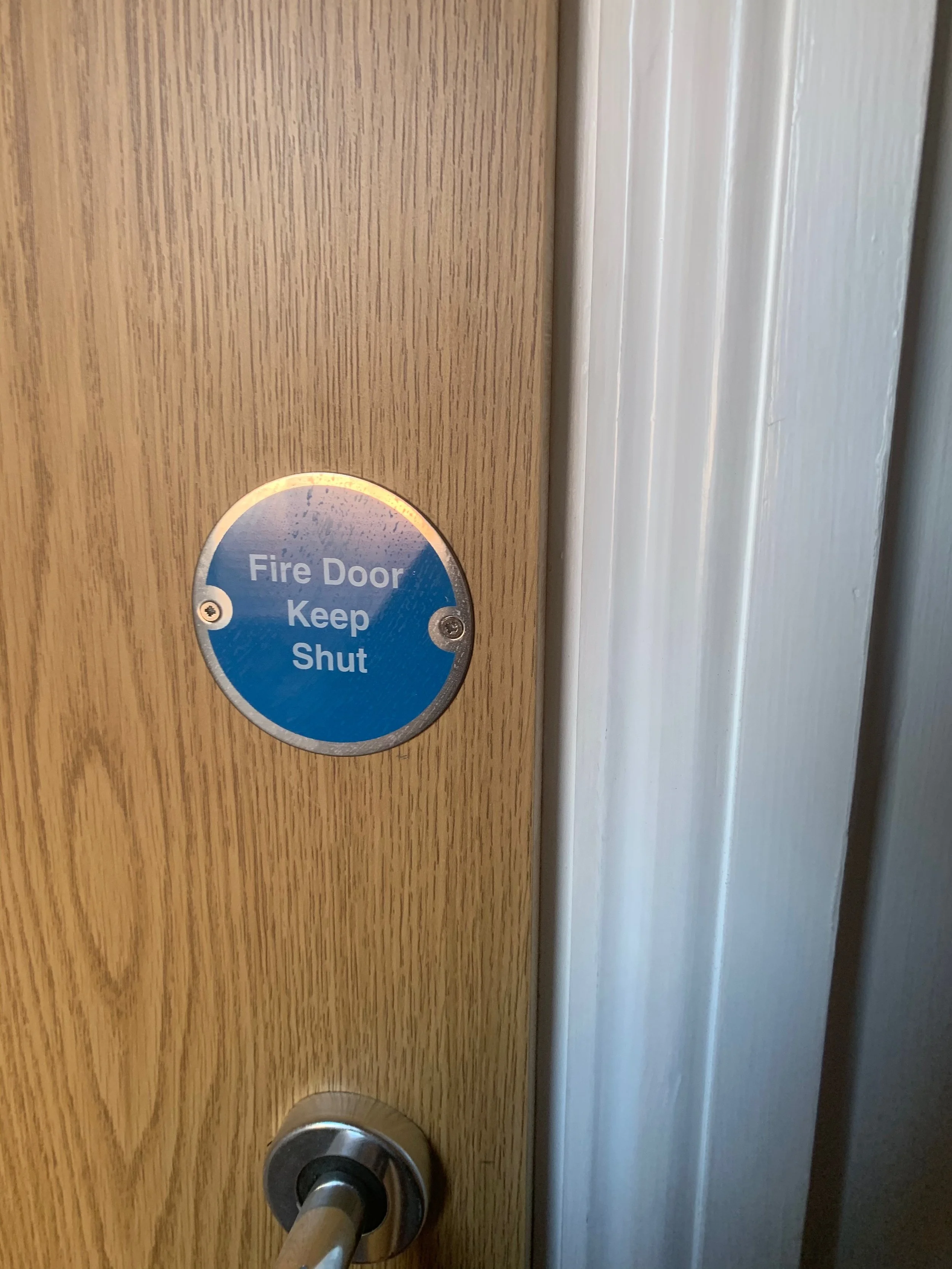
The Fire Safety College at London Fire Consultants Gains Accreditation to Deliver FireQual Qualifications
The Fire Safety College at London Fire Consultants is pleased to announce that we have gained accreditation to deliver FireQual qualifications.
This is an important step for our centre and for the learners, employers and fire safety professionals who trust us for credible, regulated training. It strengthens our ability to offer recognised qualifications that support real competence in the fire sector, while expanding the range of specialist pathways available through our training centre.
FireQual is a specialist awarding organisation regulated by Ofqual and Qualifications Scotland Accreditation. Its qualifications are designed for those working within fire safety and related technical disciplines. By gaining accreditation to deliver FireQual qualifications, The Fire Safety College can now provide learners with access to additional regulated routes in key areas of fire safety practice, including specialist technical subjects that are increasingly important across the built environment. This supports our wider commitment to delivering qualifications that are not only recognised on paper, but relevant in practice.
For us, this is not about adding logos or making inflated claims. It is about widening access to quality assured learning that helps people do the job properly. The fire sector does not need more weak training, vague competence claims or short courses dressed up as expertise. It needs structured learning, sound assessment and training that reflects the realities of compliance, installation, inspection, maintenance and risk management. That is the standard we aim to uphold.
Our existing training offer has already focused heavily on regulated and professionally relevant qualifications in fire risk assessment and related subjects. Becoming an accredited FireQual centre allows us to develop that offer further. It gives our learners more choice. It gives employers more confidence. It allows us to support those who want to build competence in technical fire safety disciplines through a recognised awarding body with a clear fire sector focus.
This development sits naturally alongside the work of London Fire Consultants. Because our training arm is linked to an active fire consultancy, our approach is grounded in real projects, real standards and real compliance challenges. We see the gap that often exists between theory and practice. We also see the consequences when training is too generic, too shallow or detached from the demands of the role. That is why our focus remains on delivery that is practical, evidence based and professionally credible.
The Fire Safety College has always aimed to do more than simply deliver courses. We want to help raise standards. We want learners to leave with knowledge they can actually apply. We want employers to know that training has been delivered with seriousness and integrity. Accreditation to deliver FireQual qualifications strengthens that position and supports our long term commitment to improving competence across the sector.
This is also a positive step for those looking to progress their careers. Fire safety is becoming more scrutinised, more regulated and more demanding. Clients, duty holders and employers are asking harder questions about competence, and rightly so. In that environment, recognised qualifications matter. They do not remove the need for experience, judgement or ongoing development, but they do provide a more defensible foundation than unregulated claims or attendance only certificates. FireQual qualifications give learners another route to demonstrate structured learning and assessed competence within a recognised framework.
We know that accreditation alone is not enough. What matters is how qualifications are delivered. Our commitment is to provide training that is clear, rigorous and relevant. We will continue to invest in course quality, learner support, robust assessment and professional standards across our centre. We will also continue to challenge poor practice and weak assumptions, because the fire sector needs honest training providers, not easy promises.
For current and prospective learners, this accreditation means more opportunities to access regulated fire safety qualifications through The Fire Safety College. For employers, it means another reason to have confidence in the standard of our training provision. For us, it marks another stage in building a training centre that is serious about competence, compliance and professional development.
We are proud to have achieved FireQual accreditation and we look forward to delivering these qualifications as part of our growing training portfolio.
If you are looking for regulated fire safety qualifications delivered by an experienced and professionally focused training provider, The Fire Safety College at London Fire Consultants is ready to support you.

NEW: BS 9792:2025 is the new Code of Practice for Fire Risk Assessment in Housing, replacing PAS 79-2:2020.
What is BS 9792:2025?
BS 9792:2025 is the new Code of Practice for Fire Risk Assessment in Housing, replacing PAS 79-2:2020.
It’s been restructured, updated, and aligned with:
The Fire Safety Act 2021
Fire Safety (England) Regulations 2022
PAS 9980 for external wall assessments
It applies to housing settings where people live independently, but not to residential care homes or private single dwellings.
What Does It Cover?
It provides a standardised approach to assessing fire risk in:
HMOs (Houses in Multiple Occupation)
Blocks of flats (purpose-built or converted)
Specialised housing (sheltered, extra care, supported housing)
It includes:
A structured 9-step process
Guidance on competence
Recommendations for documentation
Action planning
Person-Centred Fire Risk Assessments (PCFRAs)
New in BS 9792:2025
Here’s what’s new and why it matters:
1. Four Defined Types of FRA
Type 1: Common parts only, non-intrusive
Type 2: Common parts only, intrusive (e.g. opening up risers)
Type 3: Includes sample dwellings, non-intrusive
Type 4: Includes sample dwellings, intrusive
→ You must match the type of FRA to the building’s risk profile.
2. Person-Centred Fire Risk Assessments
For vulnerable residents
Takes into account physical and cognitive needs, lifestyle, behaviour
Supports inclusive evacuation planning
Annex E includes a model pro forma
→ PCFRAs are now integral, not optional.
3. Fire Risk = Likelihood x Consequences
Encourages separate analysis of:
Ignition hazards
Protection measures
Occupant vulnerability
Moves away from generic risk scoring
→ You’re expected to justify your conclusions based on real conditions.
4. Updated Structure and Scope
Clause 5 clarifies what an FRA is not:
Not a compliance certificate
Not a structural survey
Not a justification for shortcuts
→ You’re expected to call for further investigation when needed.
5. Emphasis on Fire Safety Management
Clause 16 focuses on policy, training, testing, records
Reinforces the importance of maintaining the fire safety strategy
→ Good management is now recognised as equal to physical protection.
Annexes That Add Real Value
Annex A: Pro forma for documenting FRAs
Annex B: Fire hazard prompt-list
Annex C: Means of escape – key risk factors (normative)
Annex D: People with specific evacuation needs
Annex E: Full guidance and PCFRA template
→ These are practical tools, not just theory.
Who Holds the Responsibility?
BS 9792 uses the term “Dutyholder” to mean:
Landlord
Managing agent
Freeholder
Anyone with control of common areas
Even if a consultant completes the FRA, the dutyholder remains legally responsible for:
The adequacy of the assessment
Implementation of the action plan
Ongoing review and updates
→ You can't outsource accountability.
What Should You Be Doing Now?
Review your current fire risk assessments
Identify if your assessments align with one of the four FRA types
Integrate PCFRA into your process for any vulnerable residents
Ensure your assessors meet Clause 7 competence standards
Update your FRA templates to reflect the model in Annex A
Document your action plan and revisit it periodically
Common Pitfalls BS 9792 Helps You Avoid
Failing to review FRAs regularly
Not recording justification for non-compliance
Missing vulnerable persons from the assessment
Confusing fire protection (mitigation) with fire prevention (elimination)
→ The new standard guides you toward better decisions.
Why It Matters
It reflects post-Grenfell reform
It supports more defensible decisions in legal or enforcement contexts
It protects residents—including the most vulnerable—from fire risk
It raises the bar for assessors, landlords, and housing providers
Questions to Reflect On
Are your current assessments clearly labelled as Type 1, 2, 3 or 4?
Are your assessors truly competent under Clause 7?
Have you implemented PCFRA for your most at-risk residents?
Have you reviewed your assessments since recent legislation changes?
Final Word
BS 9792:2025 brings much-needed clarity, structure, and focus to housing fire risk assessment.
It’s not just an update—it’s a professional benchmark.
Make sure your policies, procedures, and assessors are aligned.
Heathrow Airport Fire: Why Fire Safety Really Matters
On March 21, 2025, a fire broke out at an electrical substation in Hayes, West London. The fire did not start inside Heathrow Airport - but within hours, the UK’s busiest airport came to a complete standstill. More than 1,300 flights were cancelled or delayed, and thousands of passengers were stranded. This was not just a travel disruption, but was also a stark reminder of why fire safety matters.
Lessons from the Heathrow Incident
The fire at a substation near Heathrow exposed major weaknesses in fire resilience. It also showed how fire safety failures, even outside of a main site, can trigger widespread disruption.
Here’s a deeper look at the fire safety issues this raises:
1. Fire safety is about thinking ahead
Most people think fire safety is about alarms, extinguishers, and evacuation plans. And yes - those matter, but they are only part of the story. This incident shows that fire safety is much broader. It is not just about flames or smoke, but instead about what happens when a fire - or even a small fire related event - disrupts the critical systems and the entire business operations.
Often, fire safety is seen as separate from the wider business, however fire safety and business continuity must work together. Business continuity plans should always include fire risk, and fire risk assessments should be embedded into organisational resilience plans, and must consider the operational impact when something happens.
Fire safety planning must include:
Emergency lighting
Communication systems
Life safety systems
Access control and security
Critical infrastructure such as baggage handling, IT networks, and check-in systems.
Key questions to consider:
If a fire knocks out power in your business, what happens to your operation?
If your IT systems go down, how do you keep people moving?
If thousands of people are stuck, how do you manage that safely?
2. Importance of back-up systems
One of the most important lessons from the Heathrow incident is that fire safety also includes how you keep critical systems running when things go wrong. When the substation fire knocked out the power, Heathrow struggled to respond. Their back-up systems did not kick in properly or were not enough to keep the airport functioning.
Key questions to consider:
Can emergency systems still function?
Are our back-up systems automatic, or do they need manual activation?
How long can we run on back-up before safety is compromised?
3. Maintenance and inspection gaps can cost millions
Substations do not often make the news, however when something goes wrong, the fallout can have disastrous consequences. This incident shows how a fire in a single location - offsite and away from the main Heathrow terminals - can shut down the operations of a major airport.
Fires in substations and other high-risk technical areas are often caused by:
Electrical faults due to poor installation or aging equipment
Overloaded circuits or overheating components
Lack of airflow or cooling
Dust, corrosion or water ingress
Missed or delayed maintenance routines.
Regular inspections, must be scheduled, logged and acted on. For certain areas or equipment, more detailed or technical inspections need to be undertaken, such as thermal imaging to detect hot spots before components fail, arc fault detection for early warning of dangerous surges, or automated monitoring for voltage fluctuations and equipment stress. In high risk areas, such as substations or plant rooms, which are generally unmanned, an individual fire detection and suppression system should be installed, such as clean agent suppression or gas system.
Key questions to consider:
Are any high-risk areas within your buildings protected with dedicated suppression?
Do you treat your critical systems as part of your fire strategy - or just your operations plan?
If something failed right now, how would you know? And how would you respond?
4. Clear Communication in Fire Safety
One of the worst things during any emergency is not knowing what is going on. Passengers at Heathrow were left in the dark - both literally and figuratively.
Where fire safety is concerned, it is not enough to evacuate people - you need to lead them. Clear, accurate, and timely communication can prevent panic, reduce confusion, and keep people moving safely. That means having:
Pre-written announcements ready to go
Multilingual instructions for diverse groups
Staff trained to deliver calm, direct messages
Alternative communication systems if screens and speakers fail
In addition to communication to the public, staff members should also:
Know their role in an emergency
Be confident helping others evacuate
Understand where safe exits and assembly points are
Be trained to communicate under pressure
5. Fire risk is not a one-time assessment
Many organisations conduct a fire risk assessment and forget about it. However, organisations do not remain static - staff members change, new equipment is installed or upgraded, layouts are reconfigured, and increased capacity. Each one of these changes can affect fire safety.
Fire risk assessments should be reviewed regularly, and this is generally considered as annually. They should also be reviewed immediately after any change to infrastructure, layout or usage, or where there has been a fire or a ‘near miss’.
The takeaway
The Heathrow substation fire was a sharp reminder that fire safety is more than just having alarms and extinguishers. It is about protecting people, systems, and operations from unexpected disruption - whether the fire happens on your site or nearby. This incident revealed key gaps in back-up power, maintenance, communication, and risk planning. It showed how quickly things can fall apart when fire safety isn’t fully integrated into the wider operation. Every organisation - no matter the size or sector - should consider the impact of this incident. Fire safety must be active, ongoing, and built into the core of how you manage risk and run your business. The Heathrow fire may not have started inside the airport, but its consequences reached every corner of it. That is why fire safety can not be seen as a formality and is a critical part of keeping people safe, systems running, and business moving forward.
Fire Doors Save Lives: Why You Should Never Prop Them Open
Fire doors are one of the most important safety features in buildings, yet they are often overlooked or misused. Many people prop them open for convenience, not realising that this small act could have devastating consequences in the event of a fire. Whether at home, in the workplace, or in public buildings, keeping fire doors closed can mean the difference between life and death.
What is a Fire Door and Why Does It Matter?
A fire door is specially designed to withstand fire and smoke for a certain period, typically 30 to 60 minutes. Unlike regular doors, fire doors help slow down the spread of flames and toxic fumes, giving people more time to escape and allowing firefighters to do their job safely.
Fire doors are part of a building’s compartmentation system, which means they help contain a fire within one area, preventing it from spreading rapidly throughout the building. If these doors are left open, fire and smoke can move quickly, putting lives and property at greater risk.
The Dangers of Propping Fire Doors Open
It’s common to see fire doors propped open with wedges, doorstops, or even chairs, often for reasons like:
Making it easier to move between rooms
Improving ventilation
Allowing deliveries or equipment to pass through
While this may seem harmless, an open fire door can be deadly in an emergency. Here’s why:
🚫 Fire Spreads Faster – A closed fire door can hold back flames for at least half an hour. If left open, fire and smoke spread unchecked, cutting off escape routes.
🚫 Toxic Smoke Kills Quickly – Smoke inhalation is the leading cause of fire-related deaths. A closed fire door stops smoke from filling hallways and stairwells.
🚫 Escape Routes Become Dangerous – Fire doors protect corridors and staircases, giving people time to evacuate safely. An open door removes that protection.
🚫 Firefighters Face Greater Risks – Fire doors help contain the blaze, making it easier for firefighters to control. A wedged-open door allows fire to spread, making their job harder and more dangerous.
Fire Door Safety: What You Can Do
✅ Always keep fire doors closed – Unless they are fitted with an approved automatic release system, fire doors should remain shut at all times.
✅ Never wedge fire doors open – If you see a fire door propped open, remove the obstruction and report it to the relevant person (e.g., building manager or fire warden).
✅ Check fire doors regularly – Make sure fire doors close fully and are not damaged. A fire door with a broken seal, missing intumescent strip, or faulty hinges may not work effectively in a fire.
✅ Ensure fire doors are legally compliant – Businesses and landlords are responsible for maintaining fire doors under fire safety legislation. If you live in or manage a building with fire doors, ensure they meet current standards.
✅ Raise awareness – If you see someone propping open a fire door, educate them on the dangers. Many people do not realise how important these doors are.
Final Thoughts
Fire doors are not just another door – they are a lifesaving barrier in the event of a fire. Keeping them closed and properly maintained helps protect you, your family, colleagues, and neighbours.
It only takes a moment to shut a fire door, but that simple action could save countless lives.