Which Fire Risk Assessment Qualification is Right for Me?

Which qualification is best for you depends on what you do now, what you plan to do next, and whether you meet the entry expectations for the level you choose. The guide below uses the ProQual specifications for the Level 3 Award in Fire Risk Assessment, the Level 4 Certificate in Fire Risk Assessment, and the Level 5 Award and Diploma in Fire Risk Assessment.

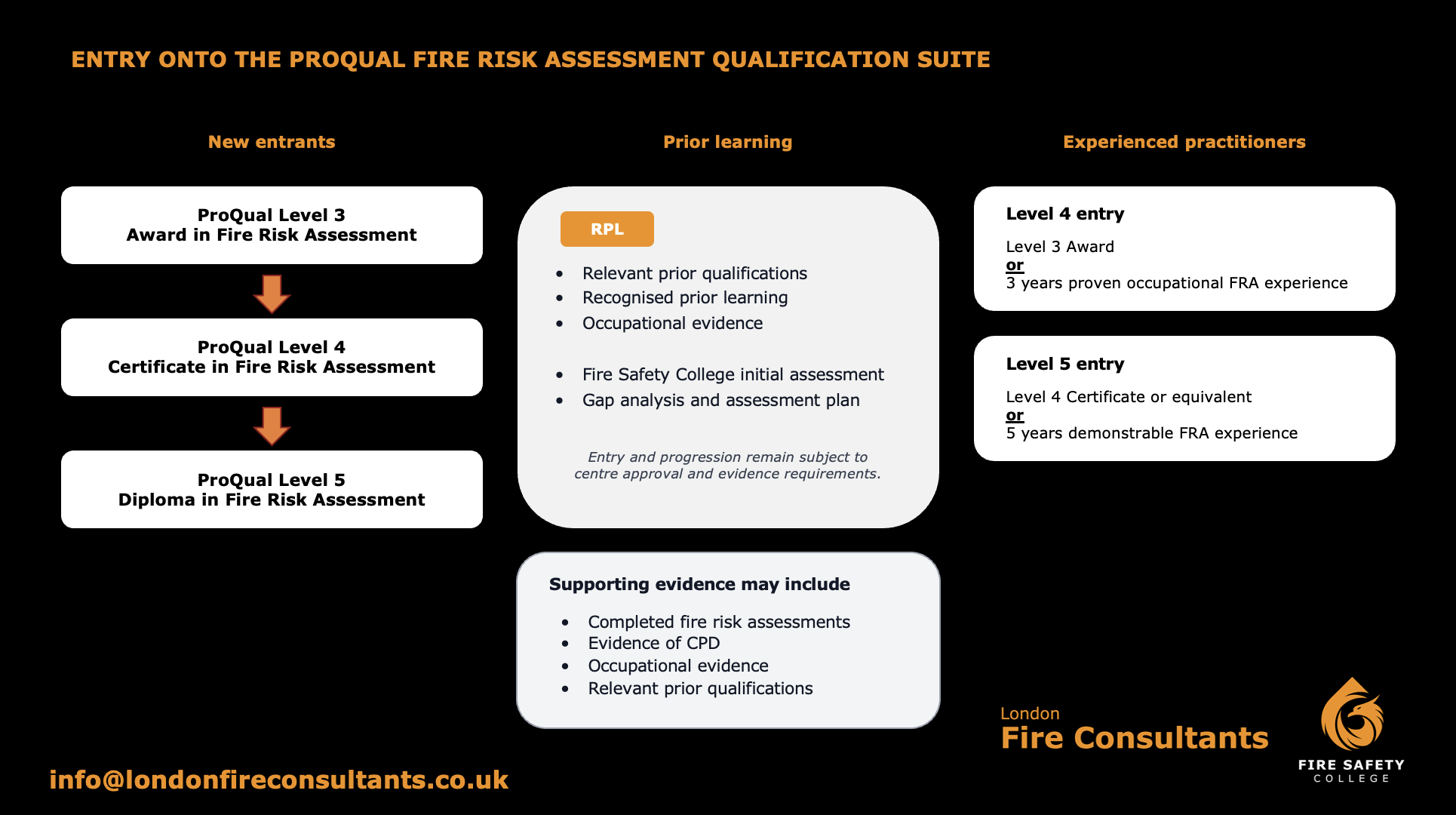
If you are new to fire risk assessment and you need a regulated foundation, the ProQual Level 3 Award in Fire Risk Assessment is usually the most suitable starting point. ProQual states there are no formal academic entry requirements, but you must be in a role or on a training course that gives you the opportunity to review fire risk assessment in a low risk building. The qualification has a Total Qualification Time of 100 and Guided Learning Hours of 60. It contains three mandatory units covering a foundation introduction to fire risk assessment, fire development and spread, and managing fire risk. ProQual also sets out progression from Level 3 to the Level 4 Certificate.

If you already carry out fire risk assessments, or you can evidence meaningful experience and you want a recognised progression step, the ProQual Level 4 Certificate in Fire Risk Assessment is designed as the intermediate route. ProQual indicates that you should hold the ProQual Level 3 Award or have at least three years proven occupational experience in fire risk assessment. You must also be employed in a role or enrolled on a training course that gives you the opportunity to carry out fire risk assessment simulations. The qualification has a Total Qualification Time of 245 and Guided Learning Hours of 160. It includes five mandatory units and requires a simulated fire risk assessment for a low risk building, as well as content focused on completing a fire risk assessment for a moderate risk building and professional development as a fire risk assessor. ProQual states progression from this Level 4 Certificate to the ProQual Level 5 Diploma in Fire Risk Assessment.

If you lead assessments, deal with complex premises, or need evidence for higher risk work, ProQual’s Level 5 routes are the advanced options. ProQual indicates that you should hold the ProQual Level 4 Certificate in Fire Risk Assessment or an equivalent qualification, or have at least five years demonstrable occupational experience conducting fire risk assessments. The specification also states you should be able to work at Level 4 or above and be proficient in English language. The Level 5 Diploma has a Total Qualification Time of 380 and Guided Learning Hours of 260, while the Level 5 Award has a Total Qualification Time of 100 and Guided Learning Hours of 80. The Diploma is the full programme with four mandatory units, whereas the Award is built from unit selection and requires a minimum of one optional unit, with the specification stating you can select any of the units. At Level 5, ProQual includes advanced expectations such as planning, leading, and reporting a simulated fire risk assessment for a high risk building, and it also includes subject matter such as external wall systems and when an FRAEW is required, including scenarios where risk becomes so intolerable that evacuation is needed.

ProQual also provides a risk scope guide aligned to IFSM groupings within the specifications. In the Level 3 context, low risk buildings are described as typically around 60 occupants. In the Level 4 context, moderate risk buildings are described as occupancies up to 500 people, with examples such as supermarkets and factory commercial units. In the Level 5 context, high risk buildings are described as occupancies exceeding 500, often with longer travel distances, single stairs, complex routes, larger fire spread areas, or multiple abnormal hazards, with examples including high rise flats, complex factory commercial units, care homes, hotels, and hospitals.

You should apply one practical test before you decide. A certificate does not automatically make you competent for every premises type, because your real scope depends on training, experience, supervision, and the quality of evidence you can produce. If you tell me your current role, the typical premises you assess, and whether you work under supervision or independently, I can map you to the most defensible level and explain the choice using only the wording and intent of the ProQual specifications.

BAFE SP205 Requirements

BAFE SP205 sets a clear expectation for competence. Clause 12.3.1 requires fire risk assessors to demonstrate and maintain the skills, knowledge, experience, and behaviours needed to complete fire risk assessments to a recognised standard. Under SP205 Version 6, you confirm your knowledge by holding a regulated qualification that has been mapped against the core competency requirements in BS 8674.

BAFE publishes a recognised qualifications document to show which regulated qualifications it accepts for SP205 (Version 6). BAFE bases recognition solely on whether the qualification has been mapped against BS 8674. BAFE updates this list by version number and makes the current version available on its website.

The recognised framework follows three competence tiers, aligned to the BS 8674 model. These tiers help you choose the right qualification for the types of buildings you assess and the level of risk you manage.

A Foundation Fire Risk Assessor can demonstrate competence to undertake fire risk assessments in buildings and premises that present a Moderate to Low, Foundation risk profile. This tier suits assessors who work within a defined, lower complexity scope and who need a regulated baseline mapped to BS 8674.

An Intermediate Fire Risk Assessor can demonstrate competence to undertake fire risk assessments in buildings and premises that present Moderate, Intermediate risk, as well as Moderate to Low, Foundation risk. This tier suits assessors who cover a broader range of premises, face more complex fire safety management issues, and need stronger justification and reporting capability.

An Advanced Fire Risk Assessor can demonstrate competence to undertake fire risk assessments across all building and premises types. This includes Advanced, High risk profiles, as well as Moderate, Intermediate and Moderate to Low, Foundation risk. This tier suits assessors who lead work in complex and high consequence environments and who need the highest level of technical and professional defensibility.

BAFE also recognises that many experienced assessors already hold legacy qualifications or have substantial occupational experience. SP205 Version 6 therefore allows experienced assessors to have prior learning and experience recognised to support access to newly regulated qualifications that meet the BS 8674 mapping requirement. In practice, this means you may be able to use recognition routes through an approved training centre so your existing competence contributes toward achieving the relevant regulated qualification.

If you are deciding which route is right for you, start with your scope. Ask yourself what risk profile of buildings you assess now, what you need to assess next, and what evidence you can produce to show competence at that tier. Your qualification choice should match the tier you operate in, not the job title you hold.

IFSM / NFRAR Requirements

The Institute of Fire Safety Managers runs the National Fire Risk Assessors Register, known as NFRAR. The register provides a way for individual fire risk assessors to evidence competence and gives Responsible Persons more confidence when appointing an assessor. IFSM sets different entry requirements depending on the level you apply for, and qualifications form a core part of that evidence.

IFSM recognises three levels on NFRAR, aligned to the complexity and risk profile of the buildings you assess. Foundation level is intended for assessors working within a simpler, lower risk scope. Intermediate level is intended for assessors working across low and medium risk buildings and includes IFSM competency checks. Advanced level is intended for assessors working across low, medium and high risk buildings and is aimed at assessors who hold third party fire risk assessment accreditation.

IFSM also sets baseline requirements that apply to all NFRAR applicants. You must hold Professional Indemnity Insurance, or work wholly within a business where Public Liability insurance covers your work activities. You must hold current IFSM membership at an eligible grade. You must provide a CPD record covering at least the last 12 months that meets IFSM requirements. You must also pay the relevant application fee.

For Foundation level, IFSM expects applicants to hold the ABBE Level 2 Certificate in Principles of Fire Risk Assessment, or another qualification IFSM considers equivalent and relevant. IFSM also expects Foundation level applicants to have less than two years of experience carrying out fire risk assessments. Where you have started completing assessments, IFSM may ask you to submit up to two fire risk assessments. IFSM states these are not assessed for detailed content, but are used to gauge your current competency level.

For Intermediate level, IFSM expects at least two years of fire risk assessment experience. You must submit two fire risk assessments completed within the last 12 months on medium risk buildings, and these must be different building types. IFSM uses these for stage one of its competency checks, looking for evidence that you can identify hazards and people at risk, evaluate and control risk, communicate clearly, and use a fit for purpose reporting structure.

Intermediate applicants must also meet IFSM’s knowledge requirement as part of stage two. IFSM allows two routes. You can provide evidence that you have passed an Ofqual regulated fire risk assessment qualification at Level 4 or higher. Alternatively, you can complete IFSM’s own knowledge exam and assignment. IFSM describes this assessment as testing both calculation and scenario based knowledge, including work with drawings, occupancy figures, travel distances and door widths, and identifying active and passive fire protection measures, alongside broader competence in legislation, guidance, ignition sources and fuel, means of escape, fire safety management, methods of fire risk assessment, and professionalism and communication.

For Advanced level, IFSM requires you to submit two fire risk assessments completed within the last 12 months on high risk buildings, again covering different building types. IFSM also requires proof of active third party fire risk assessment accreditation through one of its accepted routes. These routes include BAFE SP205 with evidence you have been audited as a validator, NSI FRAS with an in date individual certificate, or IFE Fire Risk Assessors Registration combined with Engineering Council registration.

IFSM sets ongoing expectations for those on the register. Annual renewal includes evidence of insurance and a CPD record for the last 12 months with at least 30 CPD points logged using the NFRAR CPD tool. IFSM also operates a two year competency review cycle for Intermediate level registrants. At review, IFSM states that Intermediate registrants must prove they hold a regulated Level 4 or higher fire risk assessment qualification that meets the standards within BS 8674, or complete a one off recognition of prior learning activity that provides a regulated FireQual Level 4 qualification.

Which is the best fire risk assessment course?

The best course is the one that matches your scope of work and helps you produce defensible fire risk assessments in the real world. A certificate on its own does not make you competent. You need the right knowledge, the right assessment practice, and enough feedback to improve how you work on site.

You also need to think about external expectations. Two of the most influential frameworks in the UK right now are the IFSM National Fire Risk Assessors Register (NFRAR) and third party certification routes such as BAFE SP205. They shape what “good” looks like when a client, insurer, auditor, or procurement team asks you to evidence competence.

How IFSM NFRAR affects what you choose

NFRAR uses a tiered model. Foundation level is aimed at people starting out. Intermediate level is for experienced assessors working on buildings up to medium complexity. Advanced level is for assessors working on higher risk and complex buildings and who can evidence third party certification.

NFRAR does not just look at qualifications. It checks evidence of practice. For Intermediate level, the IFSM process includes submitting two recent fire risk assessments, then completing a knowledge based exam and assignment, then completing a competency checklist to confirm you meet the Intermediate requirements.

For Advanced level, IFSM expects two recent high risk fire risk assessments and evidence of third party certification, such as BAFE SP205 or NSI FRAS, or specified IFE and Engineering Council routes.

The Fire Safety College provides direct mentoring to our learners with respect to joining NFRAR AND BAFE.

What BAFE SP205 changes

BAFE SP205 is a UKAS accredited scheme for life safety fire risk assessment. SP205 Version 6 is mapped to BS 8674 and uses the same tiered approach across Foundation, Intermediate, and Advanced.

BAFE also publishes a recognised qualifications document for SP205 Version 6. BAFE states recognition is based on regulated qualifications mapped against BS 8674 and that the recognised list is updated by version number on its website.

This matters because some clients now ask a direct question. Is your qualification regulated and mapped to BS 8674, and does it support the tier you claim to operate at?

Regulated versus non regulated courses

Many strong courses exist in the market, but they are not all regulated in the same way. Some are regulated qualifications, such as Ofqual regulated routes developed against BS 8674 expectations. For example, ProQual and FireQual has publicly described its new fire risk assessment qualification routes as Ofqual regulated and aligned to BS 8674.

Other programmes sit outside Ofqual regulation. For example, National Safety Academy states its Diploma in Fire Risk Assessment is credit rated by the Scottish Qualifications Authority at SCQF Level 10 which is not regulated by OFQUAL. NSA presents its assessment as scenario based tasks, including completing a fire risk assessment for a moderate risk premises in a “simulation.”

This is not a criticism. It is a selection issue. If you need an Ofqual regulated qualification specifically, you must check the awarding body and the regulator status before you enrol. If you do not need Ofqual regulation, you still need to ensure the course develops the competence you actually require and fits your target register or certification route.

Real competence versus simulated competence

You should choose a course that prepares you to undertake real life fire risk assessments. That means you can gather evidence on site, make defensible judgements, write clear actions, and recognise when something sits outside your competence and needs escalation.

Some qualifications assess capability using scenarios and simulations. That can be useful, especially early on, because it tests your thinking and report writing in a controlled way. NSA explicitly describes its final assessment as completing an FRA for a moderate risk premises in a “real life simulation.”

If your goal is to work independently, you should also look for routes that require evidence from real assessments, not only simulated ones, and that reflect the scrutiny used by registers and certification bodies. NFRAR, for example, requires submission of actual fire risk assessments for Intermediate and Advanced routes.

Feedback quality matters more than people admit

You improve fastest when assessors mark your work against clear criteria and explain what to fix. Feedback models differ across the market. Some providers grade pass or refer with limited narrative. Others provide structured feedback linked to learning outcomes, assessment criteria, and competence statements.

Before you enrol, you should ask one blunt question. What feedback will you get on each submission, and will it tell you exactly how to improve your next fire risk assessment?

How to decide what is best for you

If you want Foundation scope, focus on a route that builds the basics and gets you producing competent low risk reports under supervision.

If you want Intermediate scope, focus on a route that builds judgement for medium risk buildings and prepares you for evidence based checks such as submitting real FRAs and completing a knowledge assessment, as required by NFRAR.

If you want Advanced scope, plan beyond a course. You will likely need a combination of advanced study, strong real world outputs, and third party certification evidence such as SP205 or NSI FRAS, because this is explicitly referenced in NFRAR Advanced requirements and sits at the centre of the sector’s competence direction.

If you tell us your current role, how many FRAs you complete per month, and the highest risk building type you assess, we will recommend a pathway that fits NFRAR and SP205 expectations and that prepares you for real site work, not just a certificate.