
How to Select a Fire Risk Assessor Course
Choosing a fire risk assessor course is not as simple as picking the cheapest option, the shortest course or the provider with the loudest marketing. The real question is whether the course matches your current level of knowledge, your actual experience and the type of premises you intend to assess. That is where many people go wrong. They assume a single qualification can make them competent for every building type. It cannot. Fire risk assessment competence is not one size fits all. A course for a new entrant should not be sold as though it automatically prepares someone for complex or high risk buildings. Equally, an experienced practitioner should not be forced into a route that ignores prior learning, occupational evidence and existing competence. The better approach is to choose a course that fits where you are now and where you realistically need to get to.
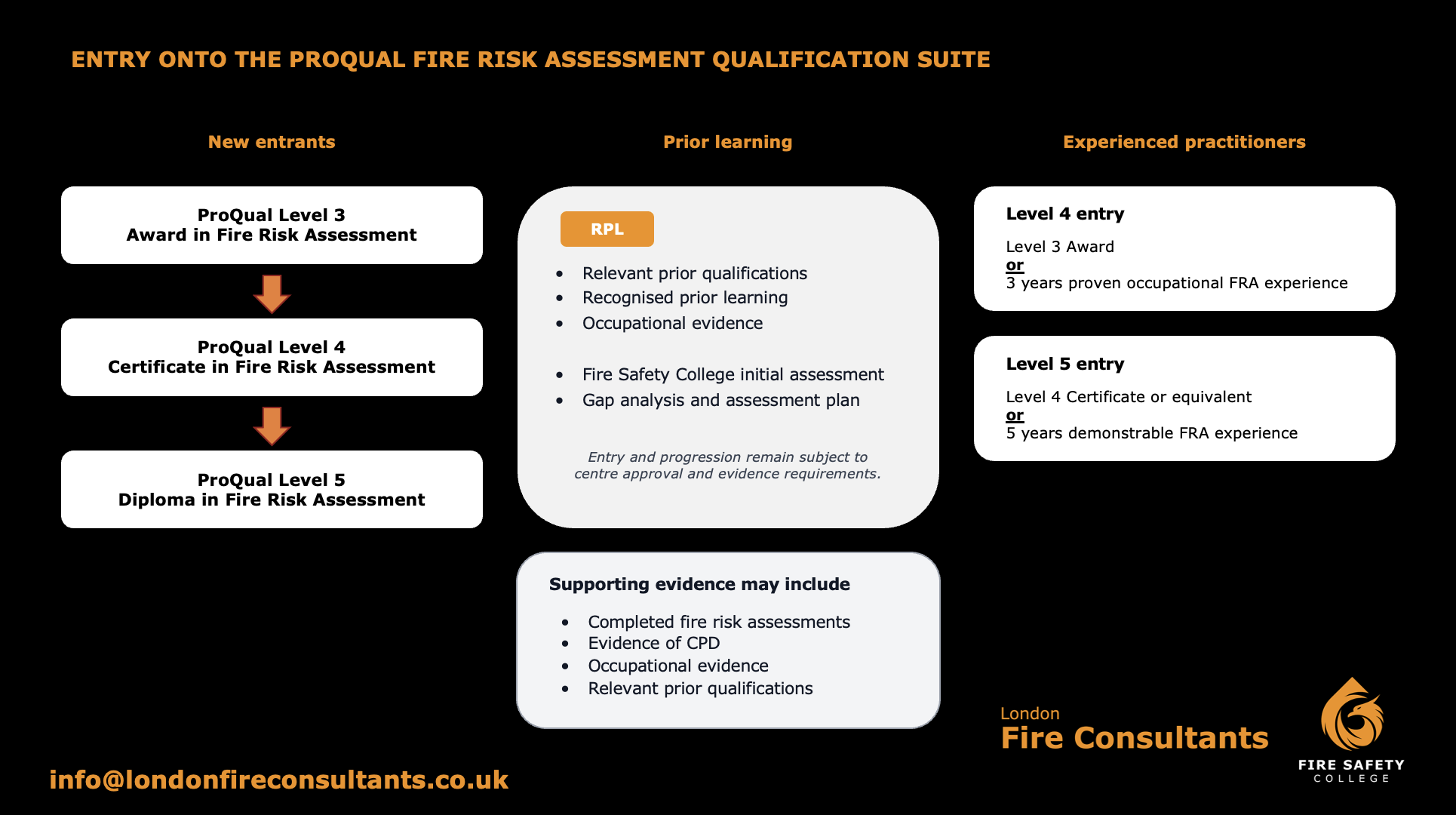
The ProQual fire risk assessment qualification suite is structured in a way that reflects that progression. For new entrants, the route begins with the ProQual Level 3 Award in Fire Risk Assessment, progresses to the ProQual Level 4 Certificate in Fire Risk Assessment and then to the ProQual Level 5 Diploma in Fire Risk Assessment. For learners with prior learning or occupational evidence, recognition of prior learning can be considered alongside an initial assessment and gap analysis. For experienced practitioners, direct entry may be possible. The Level 4 Certificate is intended for those who already hold the Level 3 Award or who have at least three years of proven occupational fire risk assessment experience. The Level 5 Diploma is aimed at those who already hold the Level 4 Certificate or equivalent, or who can demonstrate at least five years of occupational fire risk assessment experience. That structure matters because it avoids the fiction that everyone should start in the same place.
A sensible course selection process should start with honesty. What premises have you actually assessed. What level of responsibility have you held. Can you explain your methodology. Can you recognise the limits of your competence. Have you completed defensible fire risk assessments, or have you mostly followed templates and repeated what previous reports said. Those questions are more useful than asking which course sounds the most advanced. In practice, a learner with little or no meaningful experience is far better served by a solid Level 3 foundation than by being pushed too quickly into a higher level course they are not ready for. The Level 3 Award is aligned to BS 8674:2025 foundation competencies and provides a nationally recognised introduction to the principles, procedures and legislation of fire risk assessment. It has 100 hours total qualification time, 60 guided learning hours and three mandatory units covering foundation fire risk assessment, fire development and spread, and the management of fire risk.
The next step is to look closely at what each qualification is actually designed to do. The Level 4 Certificate is not simply more of the same. It is aligned to intermediate fire risk assessment competencies and is designed to build foundation and intermediate competence. It covers low risk and moderate risk buildings, evaluation of fire risk assessment materials, current legislation, simulated low risk fire risk assessments, the management of fire risk in moderate risk buildings and personal development as a fire risk assessor. It is also significantly larger than the Level 3 Award, with 245 total qualification hours and 160 guided learning hours across five mandatory units. That tells you something important. Progression is not just about collecting certificates. It is about moving into more demanding assessment work with broader technical expectations and greater professional judgement.
The same principle applies again at Level 5. The ProQual Level 5 Diploma in Fire Risk Assessment is aimed at advanced practice in high risk buildings. It is aligned to BS 8674:2025 and designed for those who want to lead and undertake fire risk assessments in high risk premises. It includes high risk building assessment, management of fire risk in high risk buildings, advanced fire risk assessment and professional development as an advanced fire risk assessor. This is not a casual next step for someone who has not yet mastered lower and moderate risk work. It is a substantial qualification with 380 total qualification hours and 260 guided learning hours. Anyone choosing a course should be wary of training providers who blur these boundaries and imply that a quicker or higher sounding course will solve competence gaps. It will not.
Another issue to examine is entry requirements. A credible provider should not treat them as optional. Entry requirements exist for a reason. The Level 4 Certificate states that candidates should hold the ProQual Level 3 Award in Fire Risk Assessment or have at least three years of proven occupational experience in the field. The Level 5 Diploma states that candidates should hold the ProQual Level 4 Certificate or equivalent qualifications, or have at least five years of demonstrable occupational experience conducting fire risk assessments. That is not gatekeeping for the sake of it. It is a basic control against overreach. If a provider is willing to wave everyone straight through without properly assessing prior qualifications, occupational evidence and learning needs, that should concern you.
This is where a robust initial assessment matters. A proper training provider should not just ask what qualification you want. They should assess your current position. That may include prior qualifications, recognised prior learning, occupational evidence, completed fire risk assessments and evidence of continuing professional development. A gap analysis and assessment plan should follow. That approach is more rigorous, but it is also more defensible. It helps prevent a learner being placed on the wrong course and makes it easier to identify what support, experience or evidence is needed for progression. If you are serious about becoming competent, that is the process you should want.
You should also examine how the course is assessed. Weak training often relies too heavily on attendance or simplistic knowledge checks. Stronger qualifications require evidence. The ProQual specifications make clear that candidates are expected to produce portfolios of evidence and, at Levels 4 and 5, to complete competency based tasks supported by assessor observation, photographic or video evidence, witness testimony and candidate reflection where appropriate. That matters because fire risk assessment is not just about what you can repeat in a classroom. It is about whether you can apply knowledge, make sound decisions, communicate findings and justify recommendations.
The provider itself also matters. You are not just choosing a syllabus. You are choosing who will shape your understanding of the role. A good provider should be able to explain where each course sits, what it does and does not prepare you for, and how it aligns with a wider competence framework. They should also be realistic about scope. No credible provider should suggest that completion of one course automatically makes you competent to assess every premises. Fire risk assessment requires qualifications, yes, but also experience, judgement, supervision, reflection and an understanding of your own limits. Any provider who skips that message is selling comfort, not competence.
At The Fire Safety College, our view is simple. Start at the right level. Progress for the right reasons. Use evidence, not ego, to decide your route. For new entrants, that often means beginning with the Level 3 Award and building properly from there. For those with relevant prior learning or occupational evidence, recognition of prior learning and initial assessment may support a different entry point. For experienced practitioners, progression to Level 4 or Level 5 should still be based on demonstrable evidence, not assumption. That approach is stricter, but it is also more honest and more consistent with the realities of fire risk assessment practice.
If you are selecting a fire risk assessor course, do not just ask which one is best. Ask which one is right for your current competence, your evidence base and the type of premises you need to assess. That is the question that protects your credibility and, more importantly, the people who rely on competent fire risk assessment.